

Ferrous Sulfate
FERROUS SULFATE
The iron mordant for natural dyeing
Ferrous sulfate heptahydrate is the standard iron mordant suitable for all natural fibers. Known historically as copperas, it tends to produce darker and moodier shades of color than aluminum. It will turn yellow dyes green, red dyes purple, and logwood dyes black. It can also be used as a reducing agent in indigo baths. Read our guide below for important safety precautions and instructions for applying it to different textile fibers.
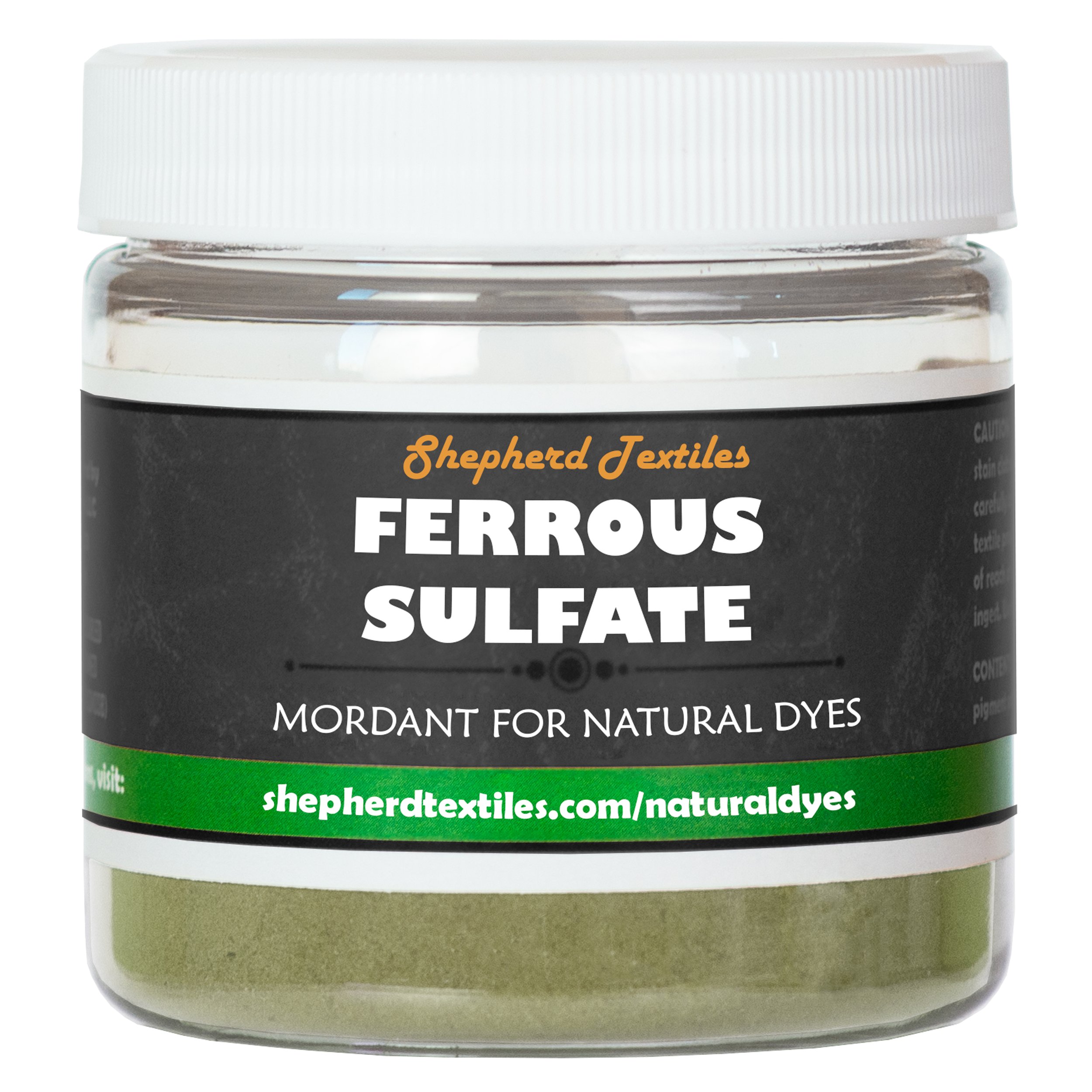
Ferrous sulfate heptahydrate is the iron salt most commonly used as a textile mordant. Historically known as copperas, it produces darker and moodier hues than aluminum. Yellow dyes turn green, red dyes turn purple, and logwood dyes turn black when they are “saddened” with iron. Ferrous sulfate can be applied with good results to all textile fibers, but care must be taken to apply it correctly or it can damage the fibers. When wool is mordanted with ferrous sulfate, a large amount of cream of tartar should be added to the mordant bath (approximately 2.5x the amount of ferrous sulfate). Cotton and linen should be treated with a tannin first, and then allowed to soak in the iron mordant bath at room temperature. Check out our guide to Mordanting with Ferrous Sulfate for more details. Sold in jars containing 100 grams.
WARNING: This product contains iron. Accidental consumption of iron-containing products is a leading cause of fatal poisoning in children under the age of 6. Store this product and all mordant baths made with it out of reach of children. In case of accidental ingestion, seek medical assistance. May cause skin or eye irritation. Wear gloves and a mask while handling. SDS available on request.
1. Background on Ferrous Sulfate
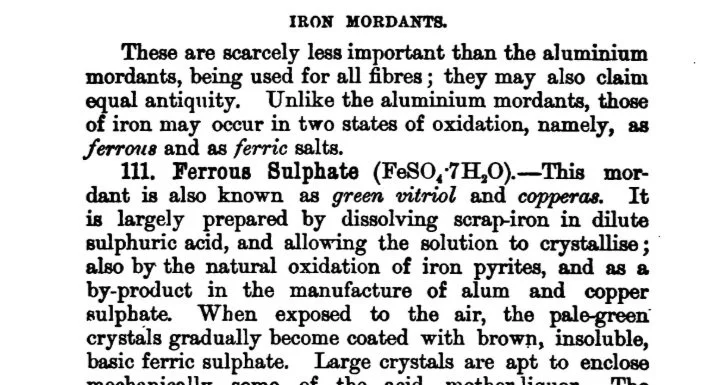
Ferrous sulfate is the most widely used and historically important iron mordant employed in textile dyeing. Known historically as copperas or green vitriol, ferrous sulfate is an iron salt that is typically formed by reacting iron with sulfuric acid. When applied as a mordant, ferrous sulfate tends to produce darker, grayer, and more subdued shades than the bright colors associated with aluminum and tin. Iron is not used for brightness and brilliance, but is very important for its ability to deepen or “sadden” colors, and it significantly improves the lightfastness of many natural dyes. It is also indispensable for dyeing black, usually in combination with logwood.
Ferrous sulfate performs well on both animal and plant fibers, although different methods of application are required for the best results. It is notable for forming strong coordination complexes with tannins (like those found in sumac galls and oak galls) even at room temperature, which makes applying it to plant fibers relatively straightforward in comparison to many aluminum mordants. Ferrous sulfate has been used by professional dyers for centuries, especially for producing blacks, grays, olives, browns, and purples, and it remains a key mordant for dyers who seek strong, durable, and historically authentic color.
2. Safety Precautions
WARNING: Ferrous sulfate may cause skin or eye irritation. Harmful if swallowed. Avoid contact with skin, eyes, and clothing. Wear gloves and eye protection while handling the dry powder and iron mordant baths, and wash hands after use. Do not ingest.
FIRST AID: In case of skin or eye contact, rinse with water for several minutes. If discomfort persists, seek medical advice. If swallowed, call a poison control center or seek medical advice. Show this information to the doctor in attendance.
This product contains iron. Accidental overdose of iron-containing products is a leading cause of fatal poisoning in children under the age of 6. Store this product, and all mordant baths made while dyeing, out of reach of children.
For textile projects only.
Open carefully to avoid spills. If a spill occurs, quickly wipe up with a paper towel or rag.
Use this product only with pots and utensils that are dedicated to dyeing. Do not use any pots, containers, spoons, tongs, thermometers, or other utensils that are also used for food preparation.
Dispose of spent mordant baths according to local regulations.
SDS available on request.
Shepherd Textiles, LLC is not liable for any misuse of this product or any unintended staining of your clothing, workspace, or other property. Use only as directed.
3. Recommended Supplies

Dye pot or plastic bucket. For mordanting wool, you will need a metal dye pot large enough to hold the fibers with enough room for them to move around and for the liquid to circulate freely. For mordanting cotton and linen, heat is not required so you can use either a dye pot or a heavy-duty plastic bucket instead.
Metal tongs. A pair of tongs is useful for stirring and taking fabric out. Use tongs dedicated to dyeing, and not for food preparation.
Rubber gloves. Wear rubber gloves while handling mordanted/dyed fiber before it is rinsed.
Cream of tartar. Cream of tartar should be added to the mordant bath when mordanting woolen-type fibers.
Candy thermometer. A cheap candy thermometer that clips to the side of the dye pot will make it easier to track the temperature.
Scale. Use a scale to weigh out the mordant and the chalk.
Tannin. A tannin like Sumac Extract or Oak Gall Light should be used when mordanting cotton or linen.
Recipes
4. Ferrous Sulfate on Wool - Premordant Method
The safest way to apply iron to woolen-type fibers is to premordant them with plenty of cream of tartar. When ferrous sulfate is applied to wool without sufficient cream of tartar, the iron decomposes from its ferrous form to its rusty-looking ferric form in the mordant bath. The subsequent deposition of ferric iron on the wool fibers will turn them an unpleasant rusty brown. The wool will be coarse, weak, and any colors dyed on it will have an undesirable “foxy” (dull brown) undertone. When an adequate amount of cream of tartar is used in the mordant bath, however, the iron will remain in its ferrous form. It will bond to the wool strongly and evenly and the wool will only take on a very slight yellowish shade. The fibers will remain soft and colors dyed on them will be clear. Afterwards, any mordant dye can applied to the wool with good results.
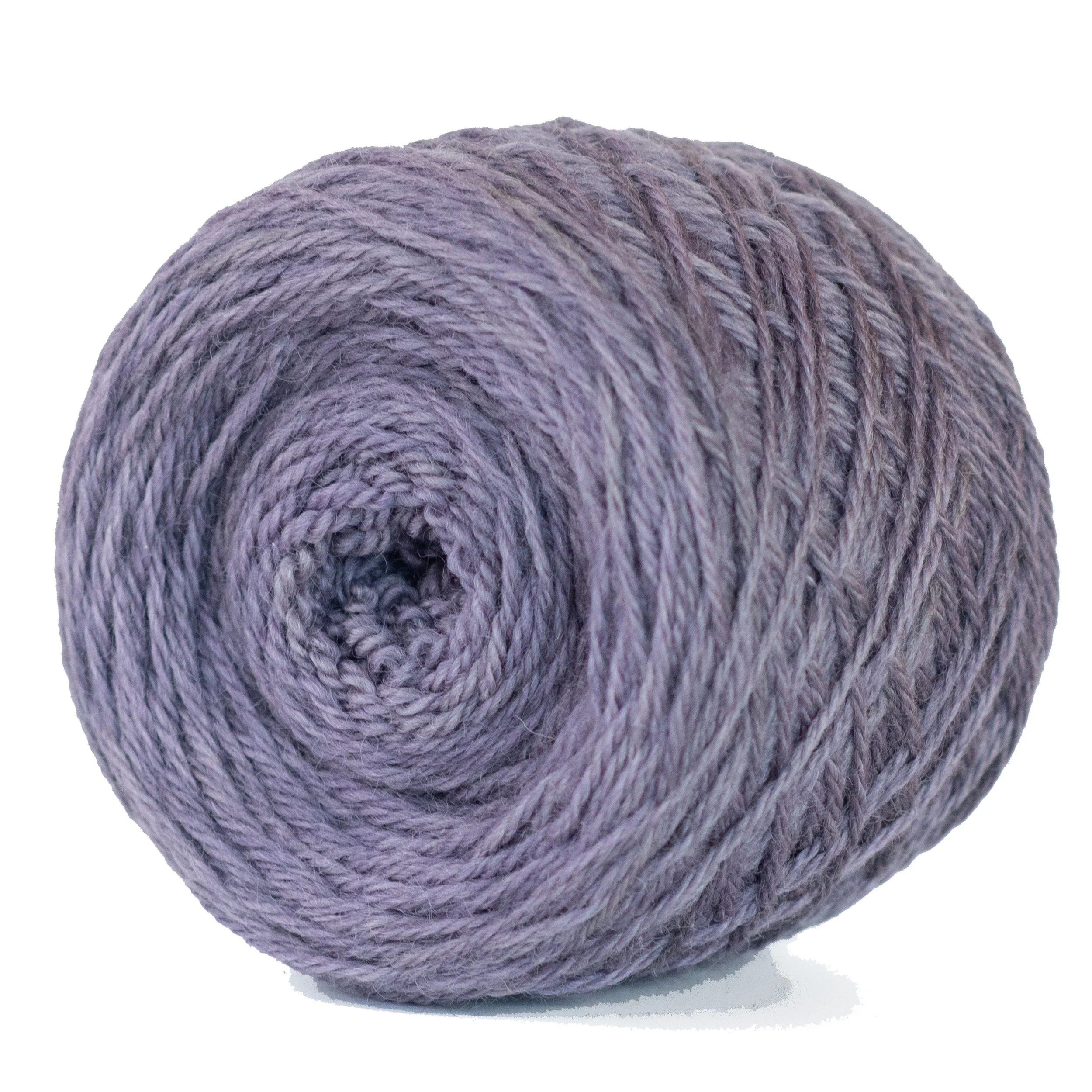
Wool yarn + 1% Cochineal

Wool yarn + 5% Cochineal

Wool yarn + 10% Cochineal
Scour the wool well before mordanting. It should be clean and fully wetted through.
Fill a dye pot with enough lukewarm water for for the wool to move around freely [see NOTE 1].
Weigh out the proper amount of Ferrous Sulfate. Use 4% weight-of-fabric (WOF) for dyeing light shades, 8% for medium shades, or 12% for extremely dark shades.
Weigh out the cream of tartar, using exactly 2.5 times the amount of ferrous sulfate. So, if you are using 4% ferrous sulfate, use 10% cream of tartar. If you are using 8% ferrous sulfate, use 20% cream of tartar. For 12% ferrous sulfate, use 30% cream of tartar.
Add the cream of tartar to the water and mix well until completely dissolved. Then, add the Ferrous Sulfate and mix well until dissolved. The cream of tartar should always be added first.
Gently add your scoured woolen fibers.
Raise the temperature of the mordant bath very gradually to just below a simmer, about 180°F-190°F. Cover the dye pot and maintain this heat for one hour. Stir occasionally to make sure the wool mordants evenly.
After one hour, remove from heat and let cool until the wool can be safely handled.
Wearing rubber gloves, remove the wool and wash in two or three rinses of warm water (without any soap or detergent) to remove excess mordant and cream of tartar. If the large amount of cream of tartar is not rinsed out it can carry over to the dye bath and acidify it, which is fine for acid-loving dyes like cochineal but it can cause issues for dyes like logwood that benefit from a more alkaline dye bath.
Proceed directly to dyeing. The swatches above show wool mordanted with ferrous sulfate and then dyed with Peruvian Cochineal.
NOTE 1. It is best if the water used for the mordanting bath is soft or distilled. Extremely hard water can interfere with mordanting because the iron can bond to the calcium in the water and precipitate prematurely. The large amount of cream of tartar used for mordanting wool will compensate for hard water to some degree, but extremely hard water can still cause issues. If the mordant bath turns cloudy and looks like it is full of rust particles, the water is too hard. Most municipal tap water should work fine, but if you know you have extremely hard water, you might need to use an alternate water source for best results.
5. Ferrous Sulfate on Cotton - Premordant Method
Ferrous sulfate has the extremely valuable property of complexing with tannins at room temperature. That is, it has such a strong affinity for tannin compounds that it will permantly bond to them even without being heated. When cotton or linen fibers are treated with a tannin, they can successfully be mordanted simply by letting them steep in a room-temperature solution of ferrous sulfate. The results tend to be very strong and level (even). Ferrous sulfate should always be applied to plant fibers in this manner. It is possible to apply ferrous sulfate to cotton simply by boiling, but the same problem occurs as when it is applied to wool without using cream of tartar: the ferrous sulfate decomposes to its ferric form and leaves the cotton coarse and rusty-looking. Any subsequent dye jobs will be superficial as well as having an unpleasant foxy undertone.

Oak Gall Extract + Iron

Oak Gall Ext. + Iron + 1% Royal Logwood

Oak Gall Ext. + Iron + 2% Royal Logwood
Scour the cotton or linen fibers well.
Treat the fibers with a tannin like Sumac Extract, Oak Gall Extract, or Oak Gall Light. See each product page for specific instructions. In general, the procedure is to dissolve 10% weight-of-fabric of the tannin extract in a dye pot with enough water for the fibers to move around freely. Add the fibers and heat the tannin bath just to a boil. Remove the tannin bath from the heat, cover the pot, and let the fibers steep for at least 3 hours or preferably overnight. Stir occasionally so the fibers tan evenly. When ready to mordant, remove the fibers and (wearing rubber gloves) gently wring out excess liquid, but do not rinse them. Proceed directly to mordanting with iron.
Fill a dye pot or plastic bucket with enough lukewarm water for the fibers to move around freely [see NOTE 1].
Weigh out 4% or 8% weight-of-fabric of Ferrous Sulfate. Use 4% if dyeing pale shades, and 8% for medium or dark shades. Add to the water and mix well until fully dissolved.
Gently add your scoured cotton or linen fibers. Wearing rubber gloves, work the fibers in the mordant bath to make sure they are evenly saturated. Make sure they are completely submerged and no bubbles are trapped underneath.
Leave the fibers to steep in the ferrous sulfate bath. Very thin fabrics like cotton will need 1 hour; thicker or more densely woven fabrics may need 2 hours. The fibers will darken noticeably and shift toward gray. Stir the fibers a few times while they are steeping to make sure they mordant evenly.
After 1 or 2 hours, the fibers will have permanently saddened to a grayish shade. Wearing rubbers gloves, remove and rinse well in warm water with 1 tsp of pH-neutral detergent per pound of cotton (we use Synthrapol). Follow the manufacturer’s directions for best results. Rinse again in a few changes of warm water until all soap suds are rinsed out and the water runs clear.
Proceed directly to dyeing. The swatches above show cottons tshirts tanned with Oak Gall Extract and then mordanted with 8% Ferrous Sulfate. The first shirt is simply mordanted with iron and not subsequently dyed; the second two shirts are mordanted with iron and then dyed with Royal Logwood Extract.
NOTE 1. The water used for mordanting should be soft or distilled. Extremely hard water can interfere with mordanting because the iron will bond to the calcium in the water and precipitate prematurely in its ferric form. When mordanting wool, the cream of tartar in the mordant bath will help to counteract hardness. However, when mordanting cotton no cream of tartar is used and hard water will cause more noticeable issues. If you dissolve Ferrous Sulfate in water and the water turns cloudy and looks like it is full of rust particles, the water is too hard to be used for mordanting cotton. Most municipal tap water should work fine, but if you know you have extremely hard water, you might need to use an alternate water source for best results.
5. Ferrous Sulfate - Saddening Method
The other main way of applying Ferrous Sulfate is through post-mordanting, or what was known to historical dyers as “stuffing and saddening.” The fibers are first saturated with a dyestuff, and afterwards iron is added (either to a separate bath, or directly to the main dye bath) and heated until it bonds with the dye and fixes it to the fiber. Whether or not saddening works better than premordanting depends on the particular dye and how well it is absorbed by the textile fiber. Saddening with iron eliminates the extra step of premordanting, and it tends to produce very level (even) colors. However, it should be done carefully with woolen-type fibers to avoid damaging them. As small a concentration of Ferrous Sulfate as possible should be used (2% is often sufficient) and the fibers should be removed from the saddening bath as soon as the color shift is complete.
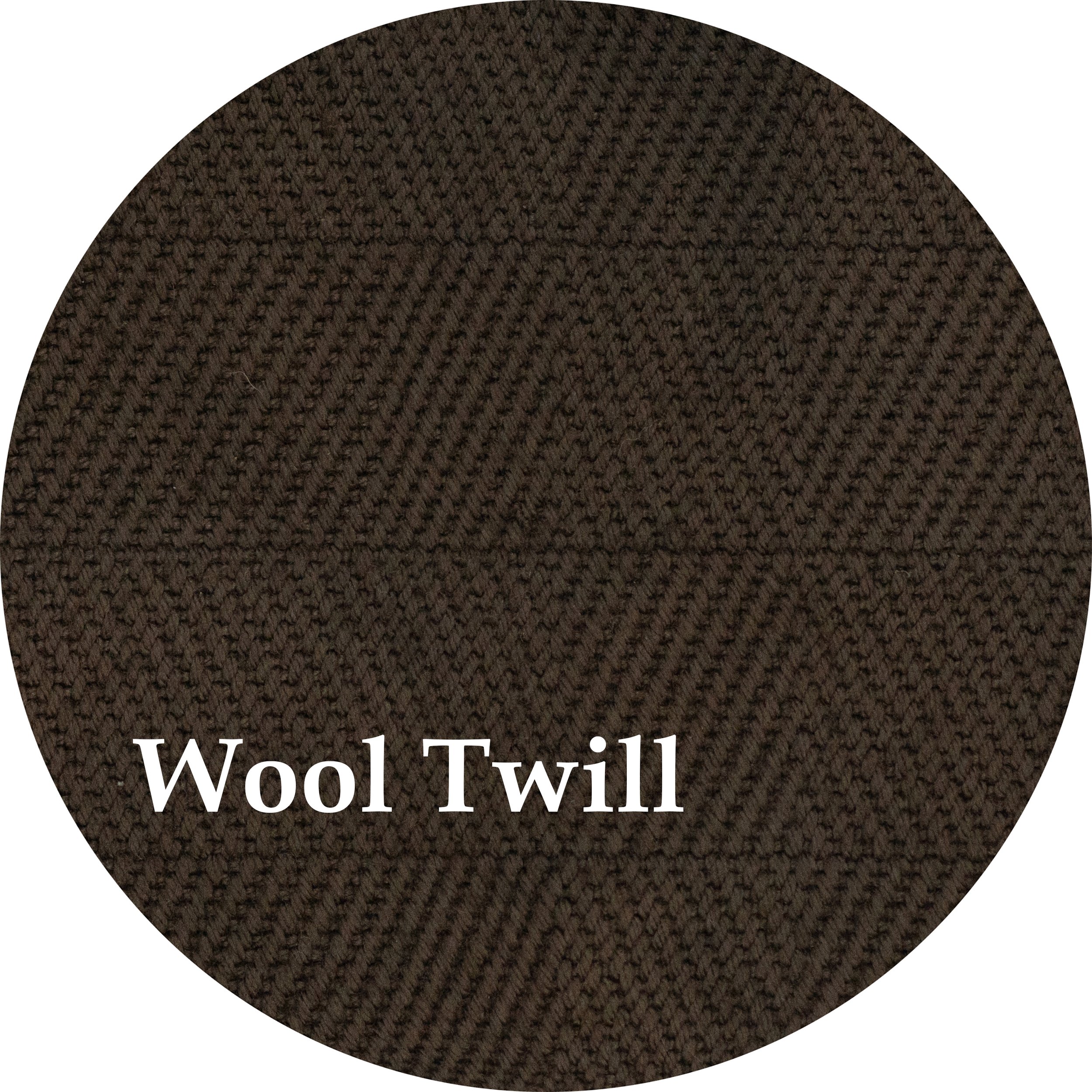
Wool + Iron + Gambir

Silk + Iron + Gambir
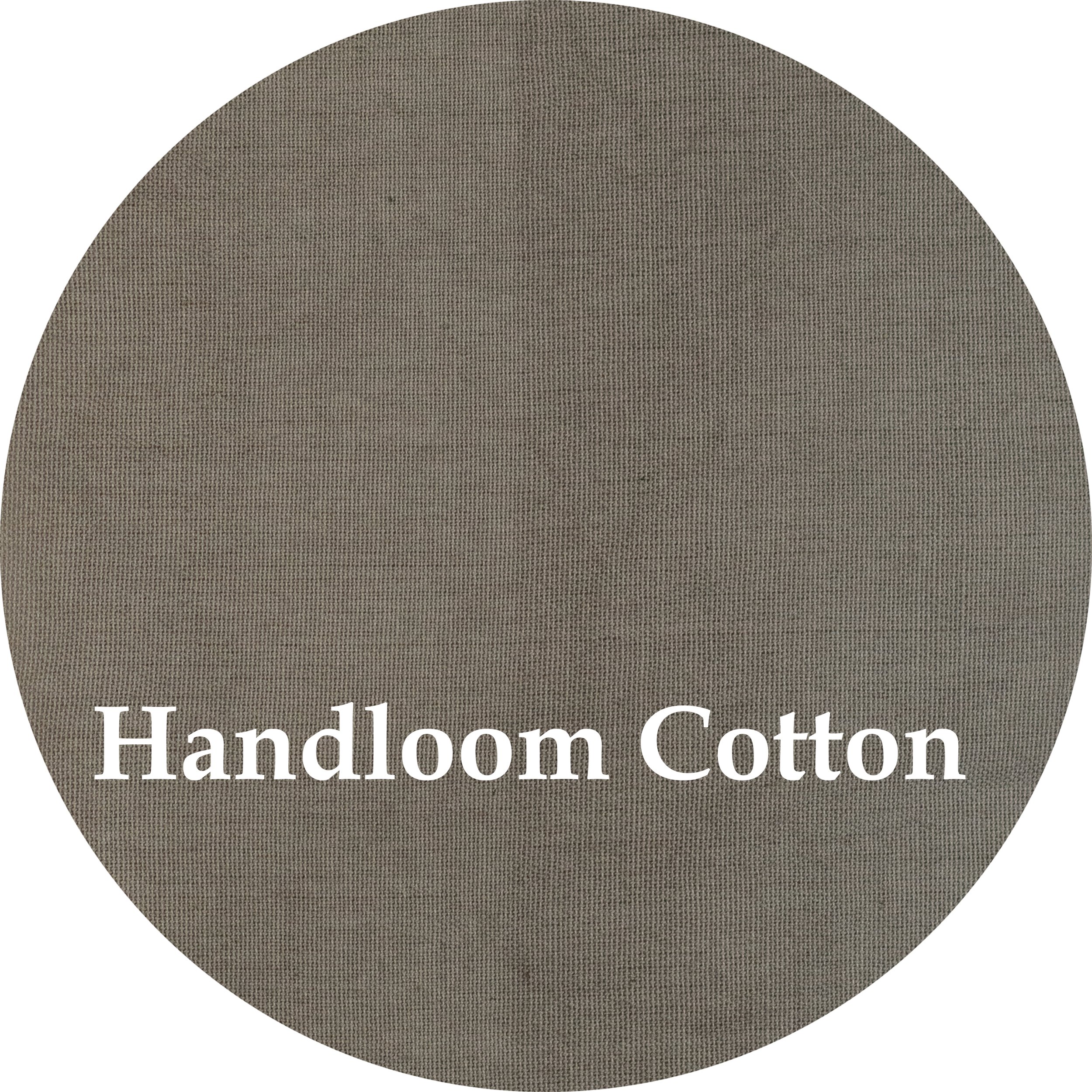
Cotton + Iron + Gambir
There is no universal recipe for saddening with iron. Each dye will be applied a little differently, and the results will depend on how well the particular dye is absorbed by the particular fiber without a premordant. The following is a general recipe based on Gambir, which is usually applied through the “stuffing and saddening” method.
Scour the fibers well before beginning, but do not pre-mordant them.
Fill a dye pot with enough water for the fibers to move around freely.
Weigh out an appropriate amount of dyestuff. The goal is to saturate the fibers as much as possible, but there is a limit to how much of any dye a textile fiber can absorb (especially when the fibers are not premordanted) so after a certain point, using more dye will not give any better results. The saddening method can be used to fix cochineal to wool, for example, because unmordanted wool will absorb a large amount of cochineal dye; but it cannot be used to fix cochineal to cotton, because unmordanted cotton fibers will not absorb cochineal at all.
Build the dye bath.
Add the scoured fibers to the dye bath. Raise the heat to 180°F (for wool) or to a gentle simmer of 200°F-205°F (for cotton and linen). Maintain this heat for one and a half hours, stirring occasionally so that the fibers absorb the dye evenly.
Meanwhile, make an iron saddening bath. Fill a second dye pot with enough warm water for the fibers move around freely. Add 2% weight-of-fabric (WOF) of Ferrous Sulfate and mix well until dissolved.
When the fibers are finished in the main dye bath, remove it from the heat and let the fibers cool down until safe to handle. Using tongs, remove the fibers from the dye bath and hold them over it for long enough for most of the excess liquid to drip back into the dye bath. Then, gently transfer them to the iron mordant bath.
Raise the heat of the iron mordant bath to 180°F (for wool) or 200-205°F (for cotton). Maintain this heat for 30 minutes, stirring occasionally to make sure the fibers sadden evenly [see Note 1]. The color should darken noticeably.
After 30 minutes, remove the mordant bath from the heat and let the fibers cool until safe enough to handle.
Wearing gloves, remove the fibers and rinse well with a pH-neutral detergent (we use Synthrapol). Hang up to dry somewhere out of direct sunlight.
NOTE 1. When saddening wool, we want it to spend as little time in the iron bath as possible to prevent any damage to the fibers. If it finishes saddening in less than 30 minutes (which can happen, depending on the dye and how loosely the wool is spun), go ahead and remove it and proceed directly to rinsing. The main thing is to be careful of thermally shocking the wool — if it is removed from a very hot saddening bath, it should be rinsed in similarly hot water to avoid felting it.
*All text and images are copyright of Shepherd Textiles, LLC. Do not reproduce without permission and attribution.