

Fine Fibers for Spinning and Crafts
A curated selection of our favorite spinning fibers. We use these in our own studio to make yarn for blankets, scarves, and other custom projects. Some, like llama, are also perfect for felting, and our tussah silk is extremely popular with cold-process soap makers. We import many of our fibers direct from mills in South America and India, and they are exclusively available from Shepherd Textiles.

An especially rare and exquisite fiber harvested by hand from the downy undercoat of wild guanaco. Guanaco are the ancestors of domesticated llama, and they still thrive in the high deserts and altiplano of the Andes mountains. They have an extremely warm and soft down coat that helps them survive cold nights in the mountains. With an average micron count of approximately 15μm, guanaco has a similar handle (feel) to pashmina or vicuña. Guanaco fiber is still harvested according to the age-old chaccu tradition: once a year, Indigenous villages build temporary paddocks out of nets, drive the local guanaco into them, shear them, and then release them back into the wild. Our guanaco combed top is the highest quality fiber intended for the Italian fashion market. It naturally has a beautiful creamy latte color, in contrast to the darker cinnamon of vicuña. It has an average staple length of between 1” and 1.5”, and will produce buttery-soft yarn. An excellent gift for fiber artists when only the best will do.
Product of Argentina. Imported by Shepherd Textiles LLC under license by the USFWS. Fully traceable through CITES (the Convention on International Trade in Endangered Species) to healthy wild populations listed in Appendix II of the treaty.
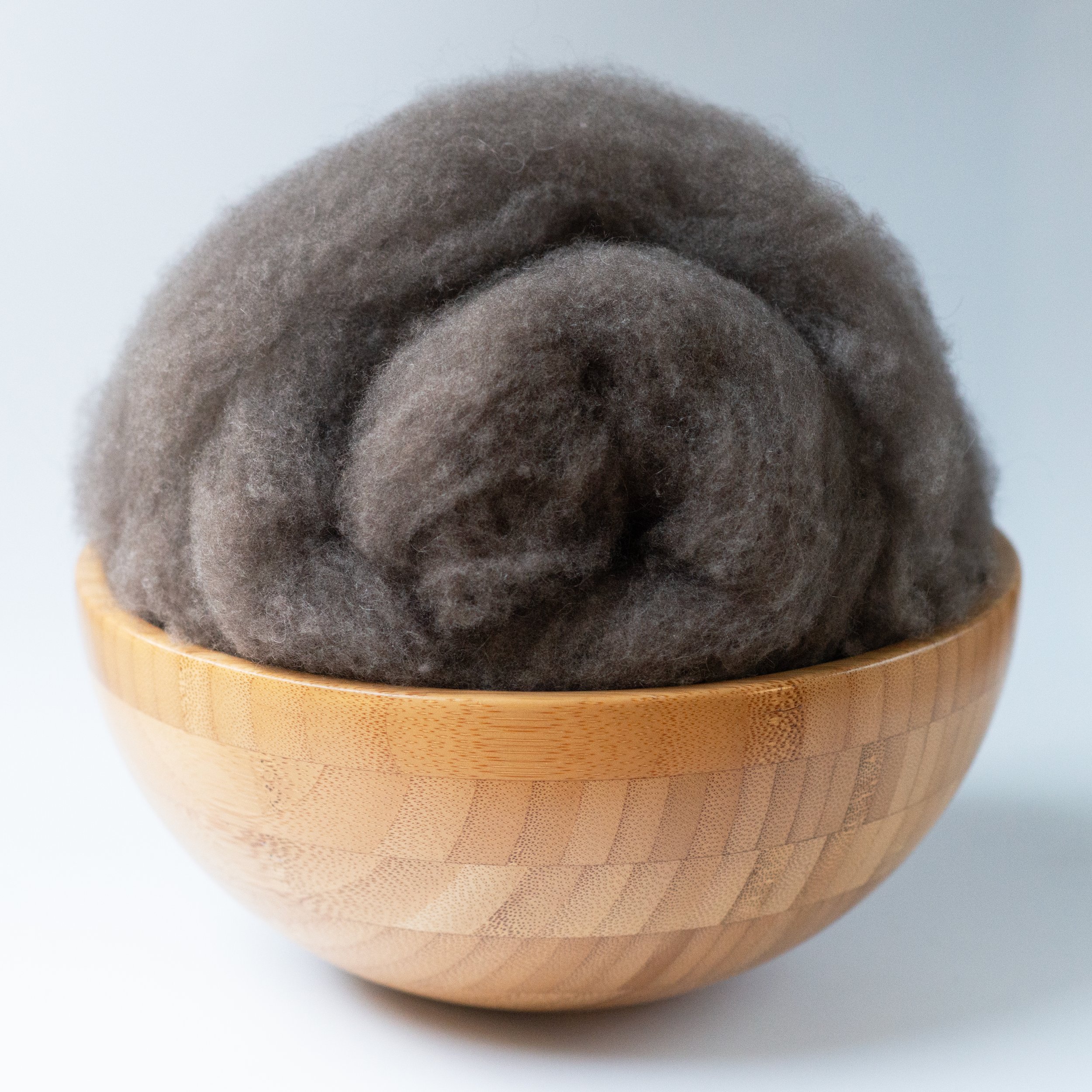
Qiviut is the downy fiber of the arctic muskox, ovibus moschatus. Muskoxen are native to the Arctic Circle, with a range that at one time stretched from Alaska to Greenland to as far east as Russia. Like many animals adapted to cold climates, they have a dual coat; an outer layer of long, coarse guard hair and an inner layer of extremely fine, warm downy fibers that allows them to survive temperatures as cold as -100°F. Qiviut is highly valued in its native range and it is often used for making hats, scarves, and gloves that stand up to the chill of arctic winters. Our qiviut fiber is gathered by hand by the Inuit and Inuvialut peoples of northern Canada, from wild muskoxen that are hunted as a traditional source of food and hides. It is thoroughly dehaired and then carded by hand into soft, cloud-like batts of fiber. This is an ultra-premium grade of qiviut, with a good 2” to 2.5” staple length, and it will spin into a wonderfully soft and warm yarn.

The only source of true pashmina is the Changthangi goat, a special breed of cashmere goat native to the high valleys of the western Himalayas. Changthangi goats are raised in small numbers by the nomadic herders that inhabit a crescent stretching from the valleys of Ladakh in northern India, across southwestern Tibet, and into the Dolpo and Mustang valleys of Nepal. In India they are raised by the Changpa, a nomadic Buddhist people who speak a Tibetan dialect. The Changpa rotate their goats across a series of high-altitude grazing grounds each year, and only small herds can survive on the sparse vegetation. Their fiber is collected in the spring when the goats begin to shed, and each adult goat produces only about 3 or 4 ounces of pashmina. This special fiber is celebrated as pashmina, “soft gold,” the finest and rarest form of cashmere.
Our Changthangi Pashmina is imported direct from northern India. It comes in loose batts of hand-carded fiber rather than as commercially combed top, because it is entirely processed by hand instead of at a mill. It is exceptionally soft—sticking your hand in it is like sticking your hand in a real cloud. The micron count is approximately 14, although expect some natural variation. Natural cream/ivory color, 1-2 inch staple length. Please note that since pashmina is carded by hand, there will be a small amount of vegetable matter (specks of grass) and some dark-colored guard hairs which can be picked out while spinning, as well as a slight goat smell that will disappear after a wash.

Our Peruvian Royal Alpaca combed top is imported directly from the mill in Arequipa. This is the finest grade of alpaca produced at the most advanced mill in South America. Fewer than 1% of all alpaca fleeces are graded as “royal,” which means the that average fiber diameter (AFD) is only 18 microns. It is only available in white, because only white-fleeced animals have been selectively bred for decades to achieve this degree of softness. And it really is buttery soft, with a hand like cashmere, but it has a good staple length of 4-5” that makes it pleasant to spin. A great choice for super-soft yarns that will be durable enough for weaving, knitting, or dyeing, but also enjoyable for against-the-skin wear.
Product of Peru. Independently analyzed by a fiber laboratory in California to confirm the average fiber diameter (AFD) of 18 microns.

Cashgora goats are the descendants of downy (cashmere-producing) goats that were bred to Angora (mohair-producing) goats in the former Soviet nations of Central Asia. This dual lineage produced a hybrid fiber with characteristics of both cashmere and mohair. Cashgora goats inherited some of the softness of cashmere, but kept the long staple and the luster that makes mohair such a charm to work with. Indeed, cashgora fiber is probably best described as somewhere between “super-soft kid mohair” and “high-luster cashmere.” The long staple makes cashgora easier to spin than cashmere and it requires less twist to hold together, so it can be made into very soft and fluffy yarns. It will also take dye beautifully. Our Cashgora is a bright white combed top with a good 3”-4” staple length and an average fiber diameter of approximately 19 microns, and it is ideal for making against-the-skin soft hats, gloves, scarves, and blankets.

Yaks (bos grunniens) are a distant relative of domestic cattle that are indigenous to the high plateaus of central Asia. Like many mammals adapted to cold climates, they have a dual coat made up of coarse outer guard hairs and an inner layer of extremely soft, warm down that helps them survive extreme cold. Yaks are fully domesticated and many Himalayan cultures depend on them for fiber, milk, cheese, and butter. They are also used as pack animals in the mountains in places where it is too difficult or remote to build roads; trekkers in Nepal often encounter entire trains of yaks laden with food and supplies, slowing winding their way up the mountain passes. Our Yak Down is made of the fine downy fibers in yaks’ inner coats, with an average fiber diameter of approximately 18 microns. It is collected when they naturally shed their inner coat in the spring and is then thoroughly separated from the coarse outer hairs. Yak down is warmer than wool and exceptionally soft, and it is perfect for making warm garments for against-the-skin wear.

Alpaca is one of our favorite fibers to work with. Good alpaca is amazingly soft, and the hollow fibers make it warmer than wool. It is also more durable under tension than merino. That makes it especially enjoyable to spin, and the yarns hold up well during weaving. We wanted to source the very finest alpaca available, so we imported this beautiful baby alpaca roving directly from the mill in Arequipa. “Baby” refers to the fineness of the fibers, not the age of the alpaca, and baby-grade alpaca is as soft as a cloud. Shepherd Textiles Peruvian Baby Alpaca has been independently analyzed by a fiber laboratory in California to confirm that it has an average fiber diameter of approximately 20 microns. This roving is wonderfully light and fluffy, and it comes in gorgeous natural tones. This is luxury alpaca fiber from the finest Andean herds. It is unavailable elsewhere in the United States. We hope you enjoy working with it as much as we do.

A Shepherd Textiles exclusive. Llamas are the largest camelid species native to the New World. They are prized as pack animals and also as guardians of sheep and alpaca. Llama fleeces combine a soft downy fiber, similar to alpaca, with a small number of longer guard hairs that give the finished yarn excellent strength and durability. We imported this gorgeous natural roving direct from the mill in southern Argentina, where enormous herds of llama still graze in Patagonia and the pampas. Rather than having it dehaired like other fiber vendors, we asked the mill to leave the dual coat so we could take advantage of llama’s natural texture. We had it independently tested at a fiber laboratory in California to confirm that the average fiber diameter (AFD) is only 25 microns, with a staple length of 6”. Our llama is softer than well-known sheep breeds like Corriedale or Lincoln, but the dual coat makes it warmer and stronger than wool. Llama is also a superlative felting fiber, wet or dry, with very little effort. This gorgeous roving is versatile enough for any project, whether it needs to be soft, durable, or both at the same time.

Camel down is a luxurious fiber that comes from the soft, fine inner coat of a Bactrian camel. It can only be collected a few weeks a year when the camel blows its coat, so it is rare and highly prized. Bactrian camel has a gorgeous natural sheen that stands out amongst all the other fine downy fibers. Our baby camel is a wonderfully light, fluffy roving with a 3” staple length, which makes it pleasant to work with.

One of our best sellers! Shepherd Textiles Tussah Silk Roving is a gorgeous, high-luster fiber harvested from the cocoons of tussar silk moths. Unlike mulberry silk moths, which have been domesticated and selectively bred for thousands of years, tussar moths still retain their wild form and produce strong, durable silk. Our Tussah Silk Roving is the lightest, fluffiest tussah silk sliver we’ve ever found. With a staple length of 5” and a light, open texture, it is perfect for spinning. Our natural white tussah silk is also popular with soap-makers—a few pinches dissolved in lye and added to homemade soap will give it a luxurious, silky feel. Try this fiber and experience just how soft wild silk can be.
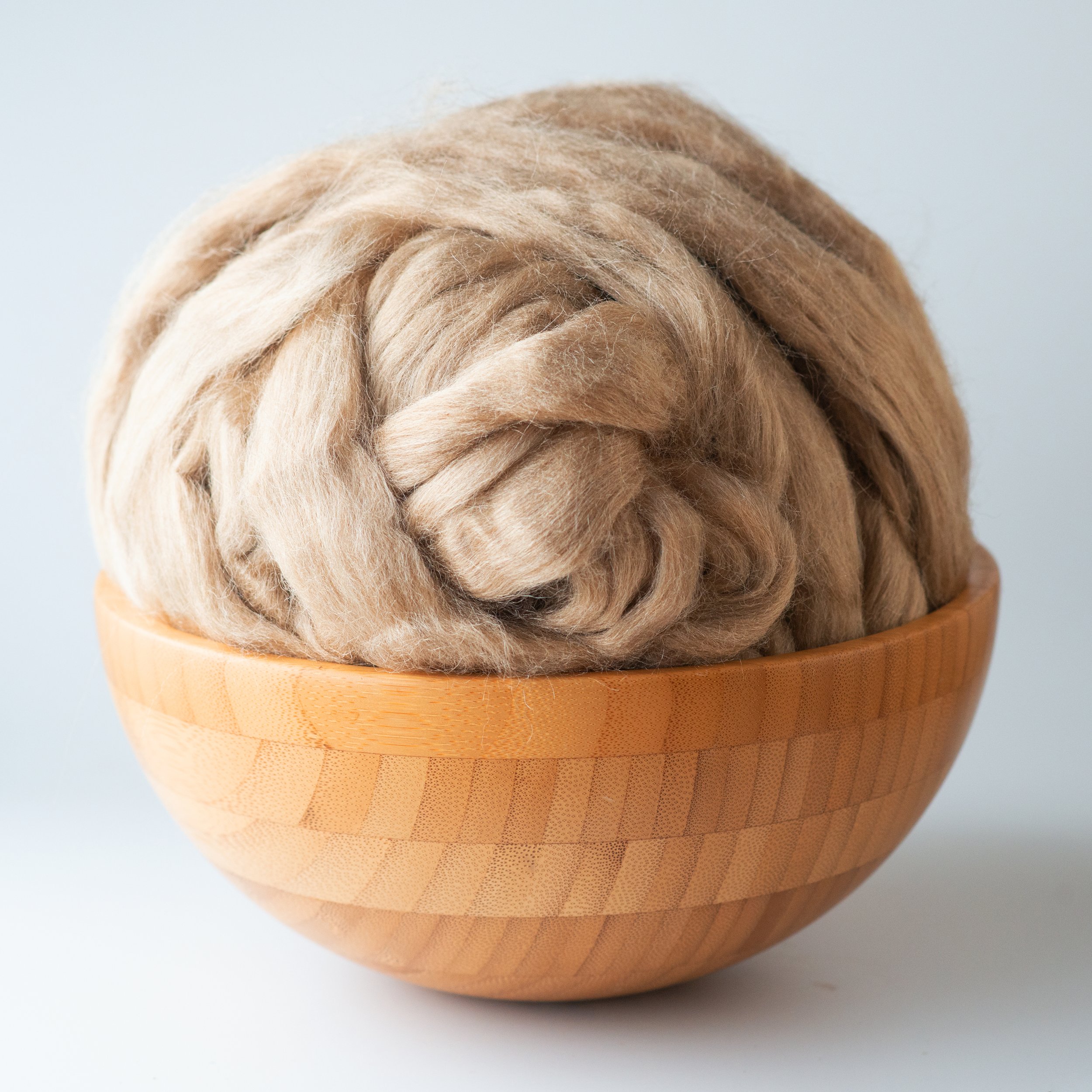
We import this wild-gathered tussah silk from a village of weavers in Odisha. Most tussah silk on the market is commercially-produced Chinese tussah silk (antherea pernyi). Although it is inevitably described as “wild silk,” Chinese tussah silk is cultivated just like mulberry silk. The silkworms are raised on farms in growing frames, and after they spin their cocoon inside the frame, the cocoons are harvested and boiled with the silkworm still inside. This prevents the adult moth from chewing its way out, which would cut the silk threads and make it impossible to unreel the cocoon as one long silk filament. The boiled larvae are then removed manually and sold as a snack or ground into livestock feed. Our Jungle Tussah Silk is produced from antherea paphia, the wild Indian tussar moth. A. paphia is not grown in frames; the moths still grow wild, and attach their cocoons to tree branches with a strong black stem called a peduncle. The cocoons are harvested after the adult moth has already exited and flown away. Unlike commercial tussah silk, this silk is not bleached. This wild silk is much coarser than cultivated tussah silk, but it has a beautiful golden glow. Product of India.
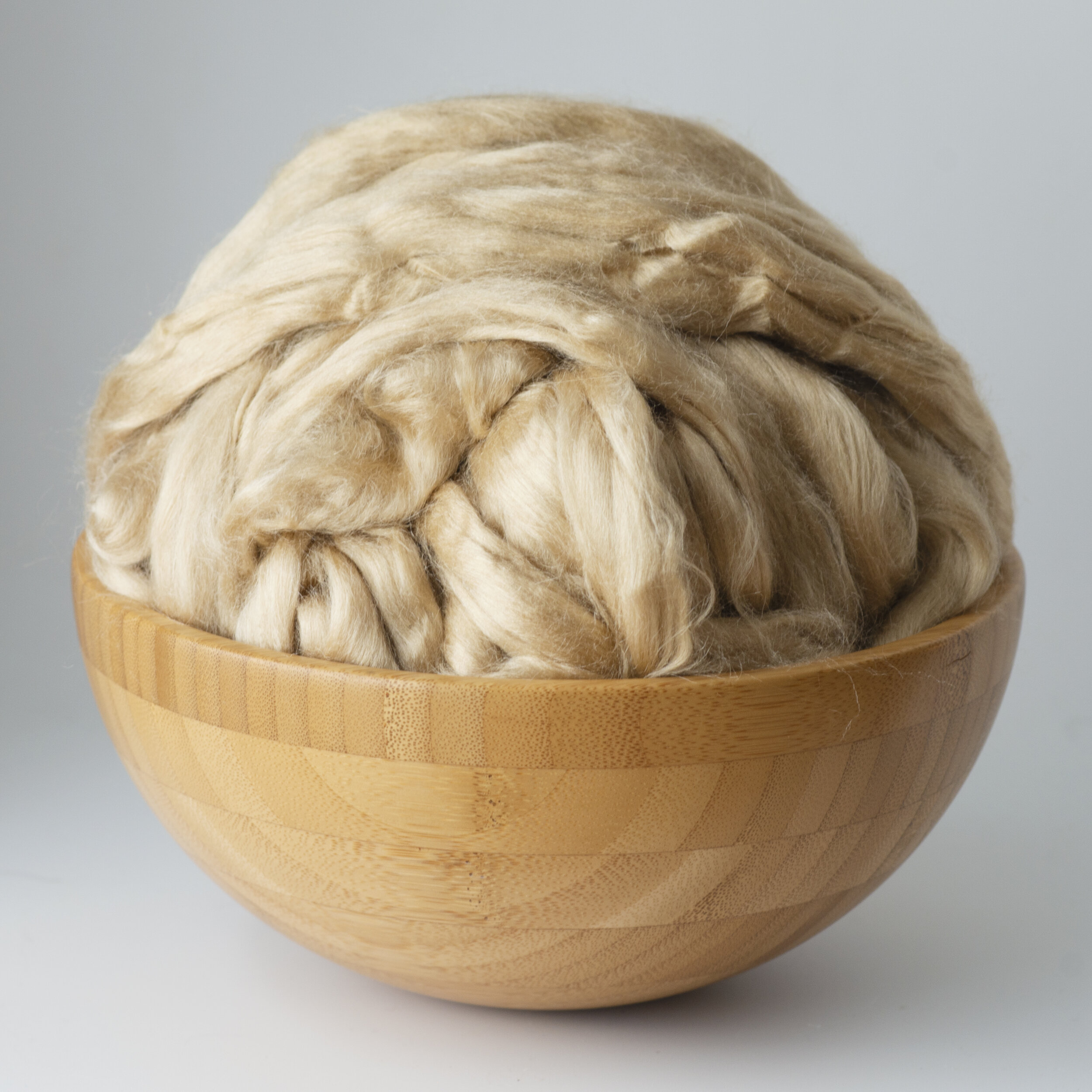
Muga silk is the rarest and most luxurious of silks, once reserved entirely for the royalty of the kingdoms surrounding the Bay of Bengal. The muga silkworm Antherea assamensis is not cultivated, and its cocoons can only be gathered in the wild. It is considered an "ahimsa" silk or "peace" silk because the cocoons are only picked after the moth has grown up and flown away, meaning no creatures are harmed to make it. Shepherd Textiles Assam Muga Silk Roving is sourced directly from a village of weavers in Odisha that has specialized in wild silks for generations. This roving is soft, fluffy, and intensely lustrous, with a 6” to 8” staple length. It can be spun into beautiful golden yarns or blended into your favorite fiber mix.

Mulberry silk is produced by Bombyx mori, a silkworm that was first domesticated by humans nearly 5,000 years ago in China. It is called “mulberry silk” because B. mori feeds almost exclusively on mulberry leaves, in contrast to other silk moths that feed on oak or castor. Mulberry silk is the finest and softest of all the silks: five millennia of selective breeding have produced a silkworm that spins cocoons of immaculately light filaments that yield strong and highly lustrous yarns. The trade-off is that B. mori has been so thoroughly domesticated that it can no longer survive in the wild; it has lost both its natural fear of predators and its ability to fly, and it has to be carefully cultivated by humans.
Mulberry silk was one of the major trade goods of the eponymous Silk Road, and during the Renaissance, Italy became Europe’s main center of silk dyeing and weaving. That long tradition continues today. Florence and its surrounding cities still produce exceptionally fine yarns and woven brocades from Chinese mulberry silk; they have also mastered the very demanding art of dyeing mulberry silk sliver without ruining its soft feel (commercial silk is nearly always dyed after the yarn is spun or woven into finished goods). Our Florentine Mulberry Silk is dyed in the city of Prato just outside Florence, using exceptionally fine Chinese silk. This is a superlative sliver with excellent hand and high luster, and is perfect for spinning bright, vibrant yarns.

A Shepherd Textiles exclusive. We wanted to add some color to our lives, but using only the very best grades of fiber available. We worked with a mill in Italy to create a premium blend of 50% ultra-fine merino (14.5 μm) and 50% mulberry silk (13 μm). The resulting roving is soft, luscious, and intensely lustrous. The colorways were inspired by the sights and seasons of the National Capital region. “Cherry Blossoms,” for example, reminds us of the cherry trees that bloom every spring on the National Mall, while “Botanical Gardens” was inspired by the greenery and bright flowers inside the U.S. Botanic Garden. These one-of-a-kind rovings are designed to draft easily and create amazingly soft and beautiful yarns.

Other luxury fibers are known for being soft and warm, but none of them can match the beautiful luster of pure silk. Shepherd Textiles Yak & Mulberry Silk Roving is a luxurious blend of 50% rare yak down fiber and 50% mulberry silk. Yak down is warmer than wool and has a soft hand similar to cashmere. It is a rare and highly prized fiber that can only be collected a few weeks a year when the yaks blow their coat. Our blend combines the warmth of yak with the shine of silk. It is also pleasant to spin, much more so than pure silk sliver, and beginners will enjoy working with it as much as expert spinners. This is an exceptional fiber meant for projects where only the best will do.

An exclusive blend of 50% mulberry silk and 50% gray cashgora. Cashgora comes from goats that are a cross between cashmere goats and Angora (mohair) goats. Cashgora fiber feels very similar to kid mohair - it is smooth, shiny, and has a long staple - but it is much finer and softer than mohair will ever be. We blended gray cashgora with mulberry silk to emphasize that natural luster and softness of these two luxury fibers. This blend has an average fiber diameter of approximately 16 microns. This is an exquisite blend that will spin up into a shimmering silver yarn. Perfect for super-soft scarves, hats, shawls, and other goods meant to be worn against the skin.

Cashmere is known as the king of luxury fibers, and for good reason. It is as soft as a cloud, but it can be spun into strong, durable yarns. Cashmere comes from the soft down brushed from kashmiri goats, usually just once a year when they naturally blow their coats. Our cashmere is a superfine grade with a staple length of approximately 2”-2.5” and a micron count of approximately 15, which means it is not just soft, it is also enjoyable to work with. Cashmere is the most heavily counterfeited of all the natural fibers, and much of what is sold as “cashmere” today is actually plain merino wool. Try our Mongolian Cashmere to experience the finest pure cashmere. Product of China.
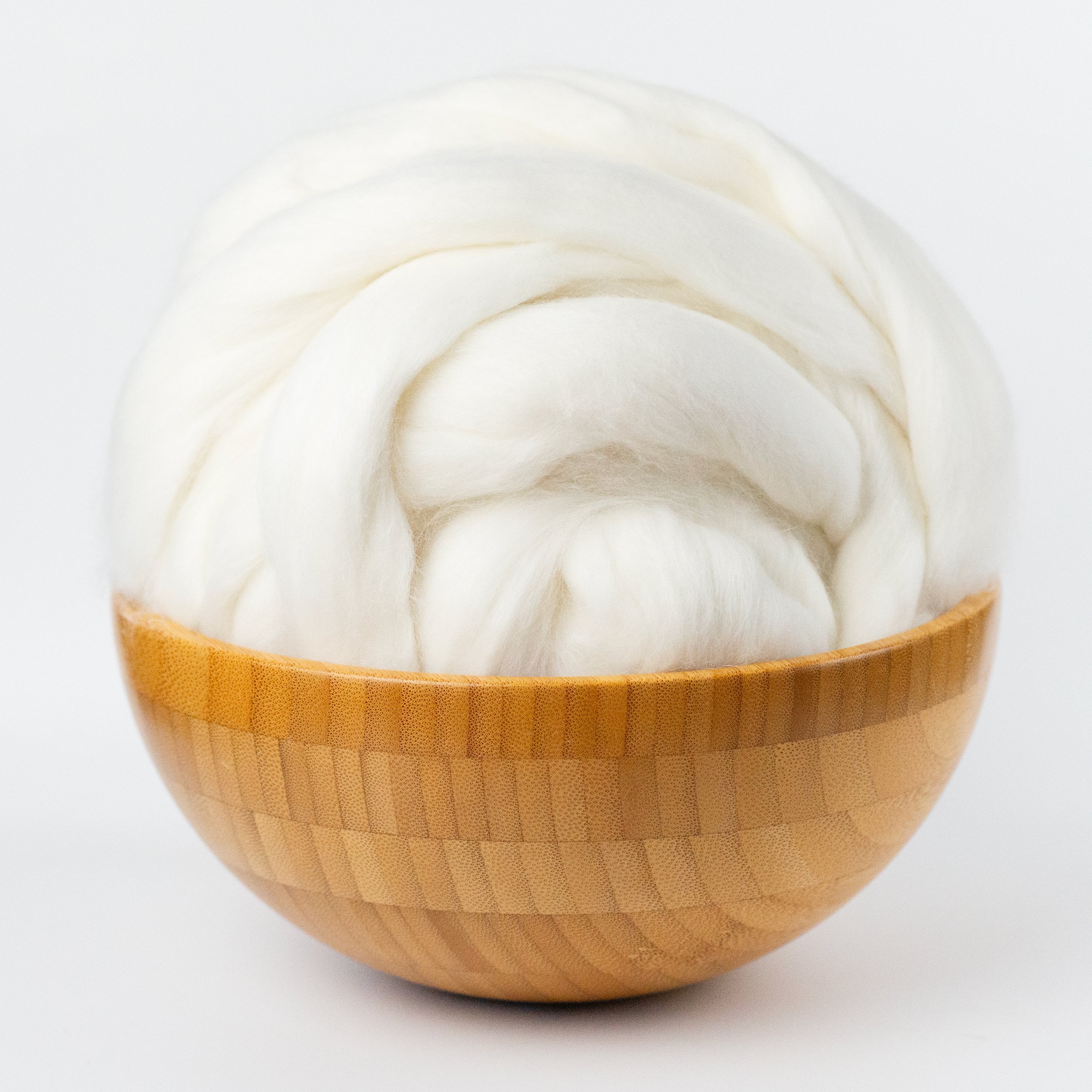
The fluffiest, whitest, warmest fiber we’ve ever seen. Shepherd Textiles French Angora Roving is the soft down brushed from French angora rabbits. It makes exceptionally warm yarns—the fibers are hollow, which helps trap heat—and they have a beautiful, fluffy halo. With a staple length of 3” and measuring approximately 15 microns, it is as soft as cashmere, although it has a very different, wispy texture. This is a luxurious fiber meant for very special projects. Our angora roving comes from Europe. An excellent choice for projects that require maximum warmth while still being as soft as possible on the skin.

Superfine alpaca is not quite as soft as baby grade, but it’s still plenty soft for against-the-skin wear, and comparable to fine merino. The average fiber diameter is approximately 23.5 microns. This is an excellent choice for big projects: when we need to spin enough yarn for a shawl or a blanket, superfine alpaca is one of our top choices because it is affordable, durable, easy to work with, and yields a wonderful final product. Our superfine alpaca comes in three natural colors. The roving is light and open, which makes it pleasant to spin, and produces yarns that are warmer than wool.
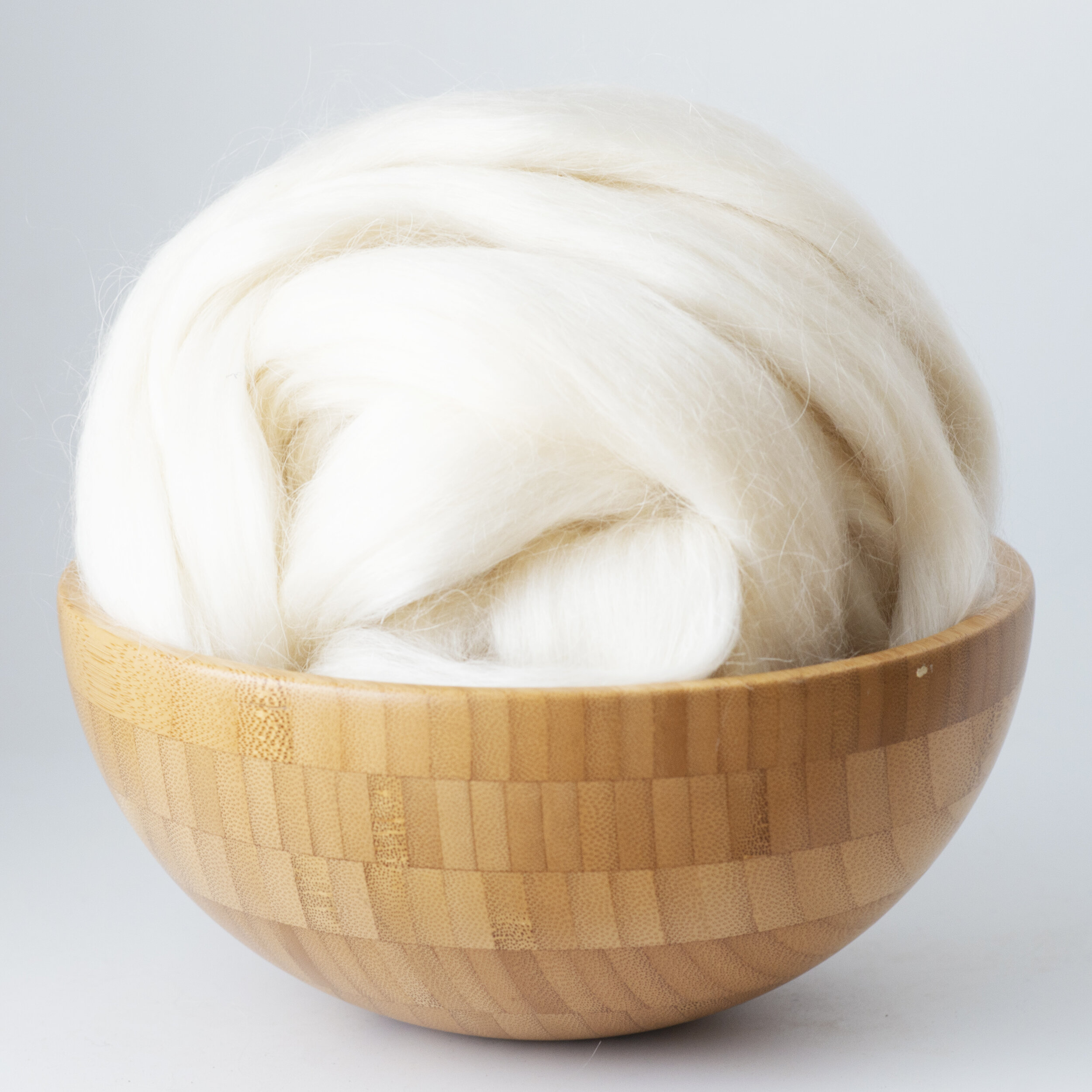
Mohair is the fiber shorn from long-haired angora goats. Angoras have a single coat, unlike other fiber animals like kashmir goats that have a layer of coarse guard hairs on top of an inner coat of down. As a result, good mohair has a longer staple length than other luxury fibers and it is very durable. Angora goats’ fiber becomes coarser as they age, so the first shearings from kid goats are always the finest. Mohair is sometimes called the “diamond fiber” because of its exceptional sheen: it refracts light almost like silk. Mohair is also distinct from wool and other fibers because it has almost no crimp. It is straight and smooth, which is why it is referred to as “hair.” Mohair makes durable and intensely lustrous yarns. Shepherd Textiles Kid Mohair Roving is the finest grade of mohair available, approximately 25 μm average fiber diameter with a staple length of 6”, from the first shearings of kid goats. Sourced from herds in South Africa.
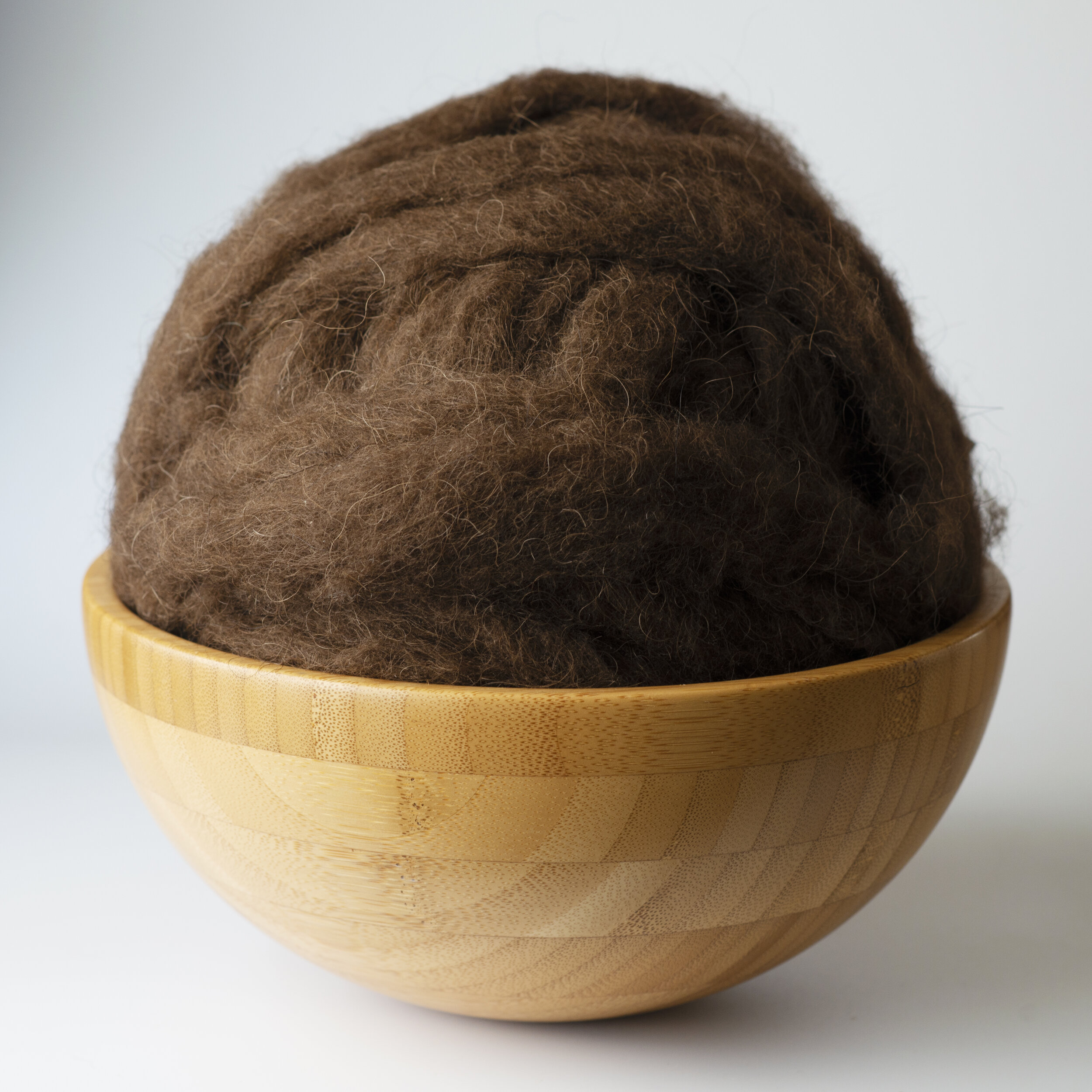
An extremely rare fiber that is available only in limited quantities. Shepherd Textiles Wyoming Bison is 100% American Buffalo fiber from a herd on the northern Great Plains. Like many other large mammals, bison have a double coat of soft, warm down underneath a coat of longer, thicker guard hairs. They shed their winter coat every spring, and it can be collected by hand—extremely carefully. The downy fibers are very soft and comparable to yak or baby camel (18-20 μm). However, because they only grow in autumn and winter, the downy fibers have a short staple length of about 1”. The roving is held together and made spinnable by the longer, coarser guard hairs that give it structure. Our Wyoming Bison roving is a rustic carded sliver made from bison fiber as it is found naturally, including both the down and the guard hairs. It is too scratchy for against-the-skin wear, but perfect for yarns intended for rugs, throws, and other durable projects. Add a genuine piece of the West to your project with real Wyoming Bison fiber.

This beautiful, exceptionally soft merino is the finest grade of wool roving available. At 14.5 microns, it is nearly as soft as cashmere, and it spins into incredibly soft yarns. If you’re cautious about wool because of a bad experience with a prickly sweater, try this merino—it’s an entirely different experience. Only a small fraction of merino fleeces are this fine, and most of them are immediately purchased at auction by designer fashion houses. Our ultra-fine merino roving is the same grade of fiber used to make Super 180s and Super 190s suits, now available for hand-spinning and felting. Dyed in Italy by DHG.

A wonderful blend of 70% extra fine (19 μm) merino and 30% tussah silk. The merino gives the fiber warmth and softness, while the tussah silk adds a beautiful shine and extra strength. This fiber is against-the-skin soft but durable enough for garments that see regular use. Spins up easily into a lustrous yarn that will deliver a bright pop of color to any project. For examples, check out our Handspun Merino/Tussah Silk Yarn. Product of Italy.
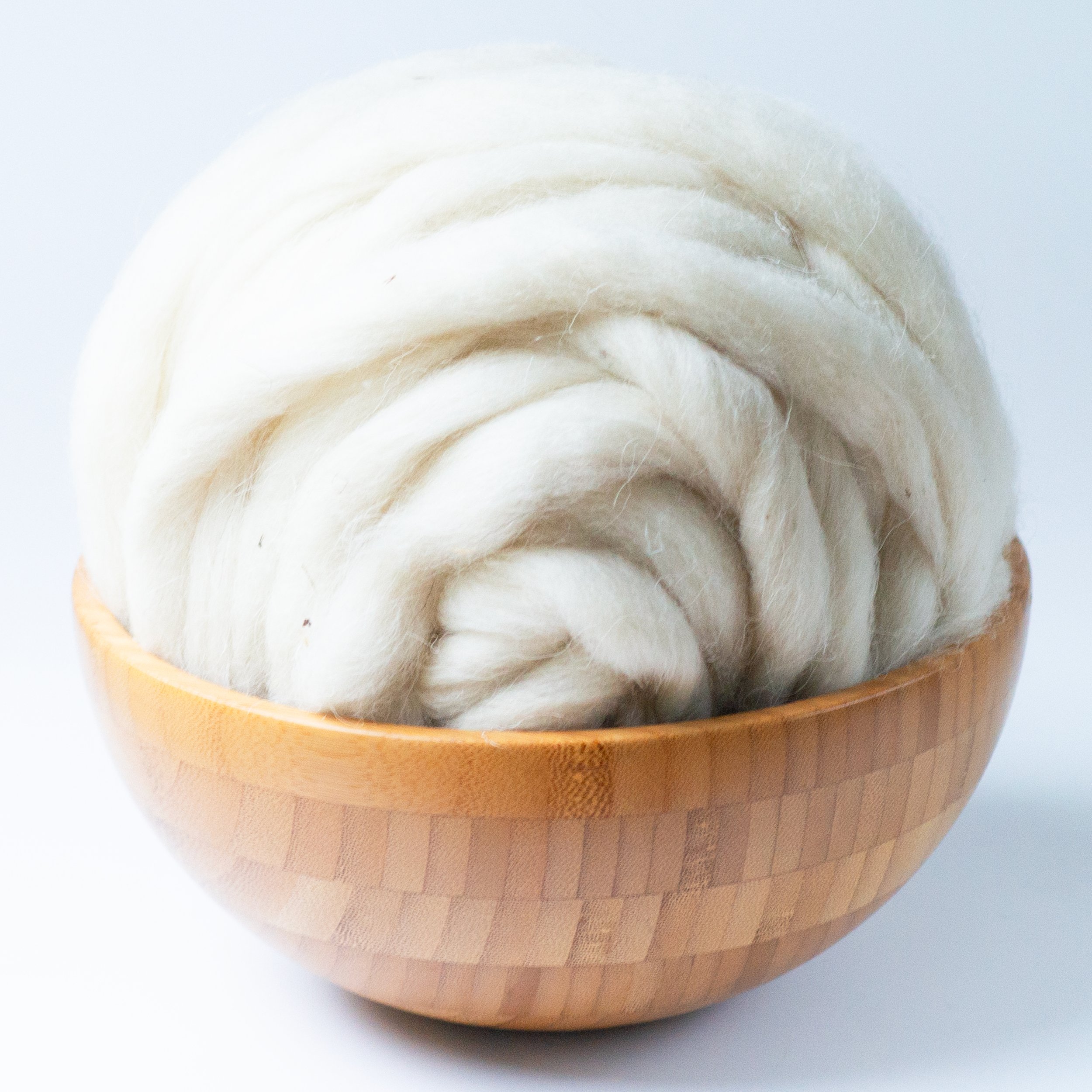
Navajo Churro are the iconic sheep of the American Southwest. Descendants of the first animals that Spanish colonists brought with them in the 16th century, churro are a hardy dual-purpose breed used for both fiber and meat. The Diné people of what is now Arizona and New Mexico began to acquire them in the 1600s, and churro quickly became an important part of Diné culture. They were raised in large herds for their meat and milk, and churro wool was used to weave beautiful rugs that are still highly valued today. Our churro wool comes from small ranchers in Arizona and New Mexico, part of the traditional range of churro sheep. This is a rustic sliver that still has a few off-color guard hairs and bits of grass in it, although these are easily picked out while spinning. Churro is not a soft wool, and it is not really meant for against-the-skin wear, but it will spin into tough yarns that are perfect for weaving rugs or heavy blankets with a Southwestern flair.

One of the oldest and most primitive breeds of domestic sheep. Icelandics are descended from the flocks that the Vikings brought with them 1000 years ago during their expansion across northern Europe. Like many fiber animals, they have a double coat made up of coarser guard hairs and finer down. However, with Icelandics the difference is especially pronounced, creating a versatile and balanced fiber. The outer coat is called the tog and the fibers measure about 35 μm. The soft inner coat is called the þel, and those fibers are closer to 22 μm. The combined wool is tough and durable, but the softer þel gives it a pleasant hand. Icelandic is one of our favorite wools to work with—we used to raise a few Icelandics ourselves for their fleeces—and it is very pleasant and forgiving to spin. It will never rival merino for softness, but it is perfect for projects that need a little extra durability. Ours is sourced from flocks in England, and has a 6” staple length.
This is it: the finest and most luxurious fiber in the whole world. Vicuña are the wild ancestors of domesticated alpaca, and their wool is the finest natural fiber in existence. The Average Fiber Diameter (AFD) is only 12 or 13 microns, and many fibers measure only 7, 8, or 9 microns. Touching vicuña fiber is like touching a cloud. Most of the annual harvest is bought up by the elite Italian fashion designers, who turn this same fiber into luxurious yarns, scarves, suits, and jackets. We are making raw vicuña fiber available for the very first time for hand-spinners and fiber artists. Please note that wild vicuña fiber has a short staple length; the individual fibers measure between 1 inch and 1.5 inches long, so extra care is required when spinning.
To learn more about vicuña fiber and the vicuña trade, please check out the Frequently Asked Questions on our main vicuña page.
* All Shepherd Textiles vicuña products are imported under license by the U.S. Fish and Wildlife Service, and in accordance with the Convention on International Trade in Endangered Species (CITES). Our vicuña is fully traceable to healthy wild populations listed in Appendix II of the treaty. Please note that all sales of vicuña products are final. Also, note that vicuna products cannot be shipped internationally, neither by us nor by third-party shipping consolidators.