

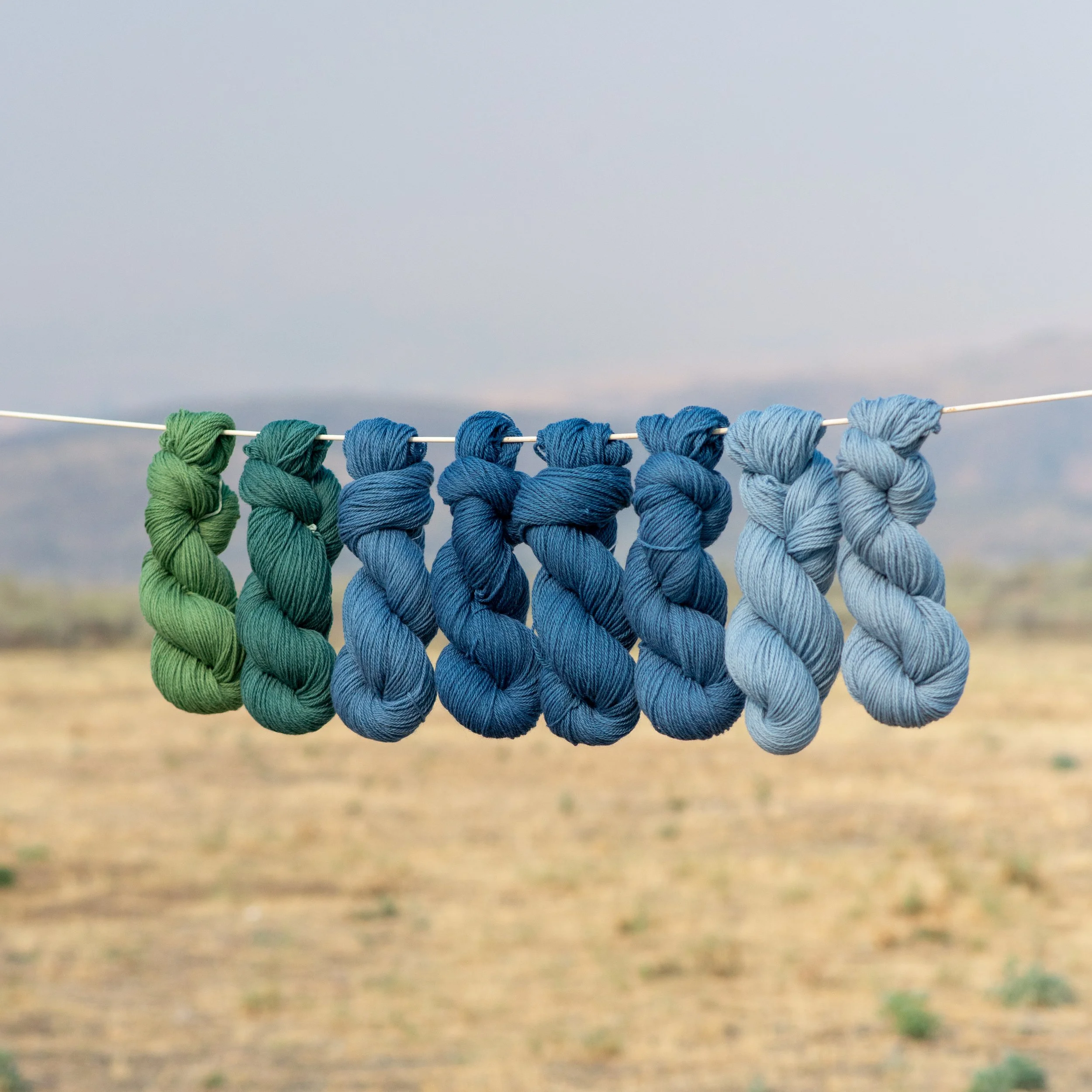
GARDENIA BLUE
Gardenia Blue
BLUE WITHOUT THE VAT
Shepherd Textiles Gardenia Blue natural dye is made from the seeds of the cape jasmine, gardenia jasminoides. Gardenia seeds were used for centuries as a yellow dye in East Asia, and in the 1980s Japanese scientists discovered that they would also produce a blue pigment when reacted with an amino acid. Gardenia blue is now used extensively in Japan, Korea, and China as a colorant, and it makes an effective textile dye on wool and silk. Although not as lightfast as indigo, it produces similar hues without requiring a reduction vat. Use at 5-10% weight-of-fabric for medium blues, with or without a mordant.

Shepherd Textiles Gardenia Blue natural dye is made from the seeds of the cape jasmine, gardenia jasminoides. Gardenia seeds were used for centuries as a yellow dye in East Asia, and in the 1980s Japanese scientists discovered that they would also produce a blue pigment when reacted with an amino acid. Gardenia blue is now used extensively in Japan, Korea, and China as a colorant, and it makes an effective textile dye on wool and silk. Although not as lightfast as indigo, it produces similar hues without requiring a reduction vat. Use at 5-10% weight-of-fabric for medium blues, with or without a mordant. Before using, check out our Guide to Dyeing with Gardenia Blue for background, safety information, and color recipes.
1. Background on Gardenia Blue
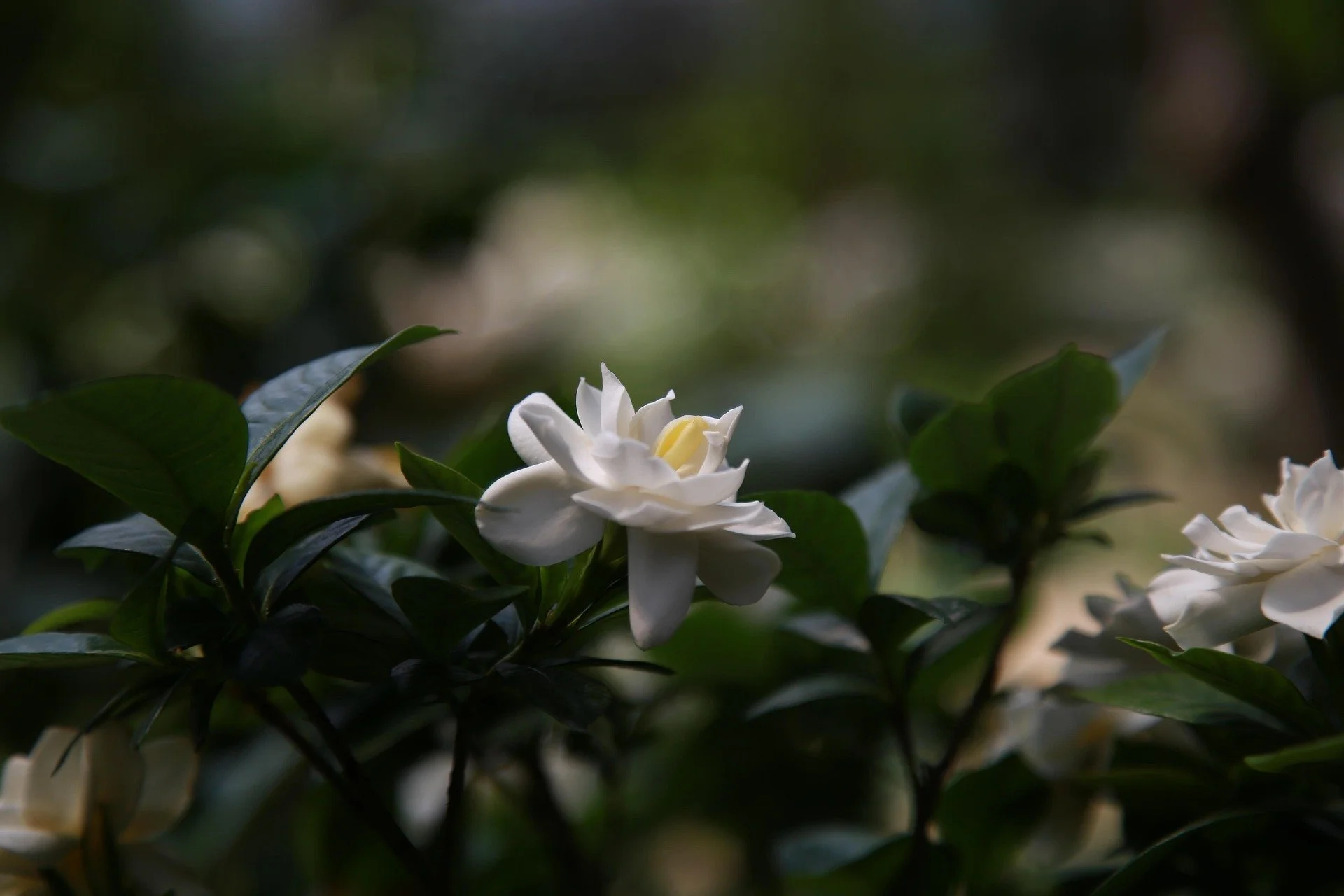
Gardenia Blue is produced from the fruit of the cape jasmine, gardenia jasminoides, a flowering shrub native to southern China. Gardenia seeds are rich in a yellow pigment called crocin — the same yellow pigment found in saffron threads —and they have been used as a natural yellow dye for many centuries in East Asia. In the late 1980s, a Japanese scientist discovered that one of the compounds in gardenia seeds could be converted to a blue pigment. The process involves reacting a compound called genipin in the seeds with one of the basic amino acids, like glycine (found in legumes) or tyrosine (found in cheese). This leads to the formation of the blue pigment now referred to as Gardenia Blue.
Gardenia Blue is significant for natural dyers because there are only a handful of natural blue dyes, and outside of indigo most of them are unsuitable for use on textiles. Spirulina (made from algae) and red cabbage extract, for example, are blue dyes that are used in food products but they are too easily degraded to be useful on fabrics. Gardenia Blue, on the other hand, is stable at high temperatures (so it can be applied in a hot dye bath) and can survive being soaped and washed. It has modest fastness to light — indigo is still the gold standard for lightfast blues — but otherwise it has good fastness to rubbing and crocking and requires neither a mordant nor a reduction vat.
Shepherd Textiles Gardenia Blue is a highly concentrated gardenia blue pigment that produces a tone of blue similar to indigo. It gives the best results on woolen fibers and on silk, although it can also be applied to cotton for lighter shades. The most important key to success with Gardenia Blue is to make sure the dye bath has been adjusted down to about pH 4: the pigment bonds most successfully with textile fibers in a mildly acidic dye bath. Use at 1% weight-of-fabric (WOF) for pale ice blues, or 5%-10% for medium blues.

2. Safety Precautions
This product is intended for textile projects only.
Not for use in food, cosmetics, or hair care products.
Do not ingest.
This product is not classified as hazardous under GHS (the Global Harmonized System for identifying hazardous chemicals). However, it is a strong dye and we still recommend basic handling precautions appropriate for any dyestuff or pigment. Wear gloves while handling the dry powder. Avoid direct contact with skin and eyes: in case of contact, flush with water. Work in a well-ventilated space and avoid inhaling dust. Wash hands after use.
Open carefully to avoid spilling or creating dust. If a spill occurs, quickly wipe up with a paper towel or disposable rag to help prevent staining.
Gardenia Blue can permanently dye clothing, countertops, rugs, utensils, or other property. Avoid contact with anything not meant to be dyed.
Use only dye pots and utensils dedicated to dyeing. Do not use any pots, containers, spoons, tongs, thermometers, or other utensils that will be used for food preparation.
Gardenia Blue, and all dye baths and mordant liquors made while dyeing, should be stored out of reach of children and pets. Use only with adult supervision.
Shepherd Textiles, LLC is not liable for any misuse of this product or any unintended staining of your clothing, workspace, or other property. Use only as directed.
3. Recommended Supplies

Dye pot. Use a stainless steel dye pot large enough to hold all your fibers, with plenty of room for them to move around and for the liquid to circulate freely. French Weld Extract may leave faint stains on metal dye pots. If so, the stain can usually be scrubbed out with a scouring pad.
Metal tongs. A pair of tongs is useful for stirring and taking fabric out. Use tongs dedicated to dyeing, and not for food preparation.
Rubber gloves. Wear rubber gloves while handling extract powder and while handling mordanted/dyed fiber before it is rinsed.
Candy thermometer. Use a thermometer to keep track of the proper temperature during mordanting and dyeing.
Scale. Use a scale to weigh out fiber, mordant, and extract powder.
Cream of tartar. Gardenia Blue works best in a mildly acidic dye bath. Cream of tartar is used to acidify the dye bath down to about pH 4, where the color will bond most efficiently to natural fibers.
[Optional] Alum. Gardenia Blue does not complex strongly with metal mordants, so a mordant is not required. However, applying an aluminum mordant can modestly improve fastness. It also makes it possible to apply other dyes to the fiber (for example, by combining Gardenia Blue with a yellow dye like Old Fustic in order to get green).
For woolen fibers and silk: Scour with a pH-neutral detergent.
Weigh out the fibers you plan to dye (while they are dry) so that you can later calculate weight-of-fabric (WOF) for the dye and the cream of tartar.
Scour (clean) the fibers well. Fill a dye pot with enough warm water for the fibers to move around freely. Add 1 teaspoon of a pH-neutral detergent like Synthrapol per pound of fiber (some dyers like to use Orvus Paste instead; refer to the manufacturer’s instructions for proper use). Add the fibers and raise the heat to 160°F (70°C). Maintain this heat for one hour, stirring occasionally so the fibers scour evenly. After an hour, turn off the heat. When the fibers are cool enough to handle safely, remove them and rinse in several changes of warm water until the water runs clear. Be sure to handle woolen fibers carefully to avoid felting them. Do not wring them, and do not move them from hot water directly into cold water, because sudden temperature changes can encourage woolen fibers to felt.
Proceed directly to dyeing.
For cotton & linen: Scour with soda ash and a few drops of soap.
Weigh out the fibers you plan to dye (while they are dry) so that you can later calculate weight-of-fabric (WOF) for the dye and the cream of tartar.
Scour (clean) the fibers well. Fill a dye pot with enough warm water for the fibers to move around freely. Add 1 gram of soda ash (sodium carbonate) per pound of fiber, plus a few drops of liquid soap like Synthrapol or, if it is all that is available, dish soap. Add the fibers and raise the heat to 180°F (70°C). Maintain this heat for one hour, stirring occasionally so the fibers scour evenly. After an hour, turn off the heat. When the fibers are cool enough to handle safely, remove them and rinse in several changes of warm water until the water runs clear.
Proceed directly to dyeing.
4. Preparation: Scouring
Textile fibers should always be scoured (cleaned) before dyeing, even if they are fresh off the shelf or out of the package and look as though they are already clean. If fibers are not scoured, areas with any dirt, grime, or oil on them will not take the dye evenly, leading to a patchy appearance after dyeing. Worse, the color may be prone to crocking or rubbing off. Scouring the fiber first will help to guarantee even results and good fastness after dyeing.
Recipes
5. Blue on Woolens - No Mordant
Gardenia Blue is primarily a substantive dye rather than a true mordant dye. It bonds directly to textile fibers like wool, and does not form a compound (a “color lake”) with metal mordants like aluminum and iron. That means that good results can be obtained by dyeing Gardenia Blue directly on clean, well-scoured, but unmordanted wool. The most important factor for success is making sure to adjust the pH of the dye bath down to around 4. Gardenia Blue has very little attraction toward textile fibers at neutral pH (7), but in an acidic dye bath it will bond to them much more successfully. In theory any mild acid could be used to adjust the pH down, but we use cream of tartar in this recipe because it is easy on woolen fibers and will not make them feel coarse.
Wool yarn, 1% WOF
Wool yarn, 5% WOF
Wool yarn, 10% WOF
Fill your dye pot with enough warm water for your fibers to move around freely.
Weigh out 10% weight-of-fabric (WOF) of cream of tartar. Add to the dye bath and mix well until dissolved.
Weigh out the appropriate weight-of-fabric (WOF) of Gardenia Blue powder. Use 1% for an ice blue, 5% for an ocean blue, or 10% for an indigo-like blue. Add the powder to the dye bath and mix well until any clumps are dissolved.
Add your wetted, scoured, but unmordanted wool to the dye bath.
Heat the dyebath to 180°F gradually, over the course of about 30 minutes, stirring regularly so that the wool dyes evenly. Maintain this heat for 1.5 hours and continue to stir occasionally. After 1.5 hours, turn off the heat and allow to cool to room temperature.
When the wool is cool enough to handle safely, remove with tongs and rinse well in warm water until the water runs clear. Soap or detergent should not be necessary, because excess dye should rinse off fairly easily with a few washes. However, if necessary, wash with a pH-neutral detergent like Synthrapol. Follow the manufacturer’s directions for best results. CAUTION: Gardenia Blue may bleed if not thoroughly rinsed.
Hang up to dry out of direct sunlight.
NOTE: Gardenia Blue does not tend to exhaust onto textile fibers, so if you are dyeing a dark shade of blue, there may be a lot of color left in the dye bath when you are finished. You may wish to have some extra scoured fiber ready to dye in this exhaust bath to get paler shades of blue.
6. Blue on Woolens - Alum Mordant
Gardenia Blue does not form a compound with metal mordants, but studies have shown that mordanting the dyed fibers with alum can still provide some modest benefits in terms of fastness to rubbing and washing, and possibly to fading as well. The other advantage of mordanting the wool is that, if you want, it can later be dyed with a standard mordant dye like cochineal or weld to get compound colors like purple or green. The best and simplest method is to dye the wool with Gardenia Blue and mordant it with alum simultaneously. Alum itself is a mild acid, and combining alum and cream of tartar will push the pH of the dye bath down to exactly where Gardenia Blue works best. Note that applying alum will not really change the depth or tone of the color — at 10% WOF the blue may be just a little bit darker using this method, but otherwise the color will look the same as if no mordant was used.
Wool yarn, 1% WOF
Wool yarn, 5% WOF
Wool yarn, 10% WOF
Fill your dye pot with enough warm water for your fibers to move around freely.
Weigh out 5.5% weight-of-fabric (WOF) of cream of tartar. Add to the dye bath and mix well until dissolved.
Weight out 5% weight-of-fabric (WOF) of alum. Add to the dye bath and mix well until dissolved.
Weigh out the appropriate weight-of-fabric (WOF) of Gardenia Blue powder. Use 1% for an ice blue, 5% for an ocean blue, or 10% for an indigo-like blue. Add the powder to the dye bath and mix well until any clumps are dissolved.
Add your wetted, scoured, and unmordanted wool to the dye bath.
Heat the dyebath to 180°F gradually, over the course of about 30 minutes, stirring regularly so that the wool dyes evenly. Maintain this heat for 1.5 hours and continue to stir occasionally. After 1.5 hours, turn off the heat and allow to cool to room temperature.
When the wool is cool enough to handle safely, remove with tongs and rinse well in warm water until the water runs clear. Soap or detergent should not be necessary, because excess dye should rinse off fairly easily with a few washes. However, if necessary, wash with a pH-neutral detergent like Synthrapol. Follow the manufacturer’s directions for best results. CAUTION: Gardenia Blue may bleed if not thoroughly rinsed.
Hang up to dry out of direct sunlight.
NOTE: After following this recipe, the woolen fibers will be both dyed blue, and mordanted with alum. If you wish, after rinsing the fibers, you can dye them with a standard mordant dye like French Weld Extract or Persian Berry Extract (to get a green), or Kusumi Lac or Peruvian Cochineal (to get a purple).
7. Single-Bath Green on Woolens
There are several ways to get a green shade using Gardenia Blue. For one, you could follow the previous recipe, then rinse the woolen fibers and dye them in a second bath with a yellow dye like French Weld Extract or Persian Berry Extract. The fibers can also be dyed green all at once using a classic “single bath” method. To do so, we will add Gardenia Blue, alum, cream of tartar, and Old Fustic Extract all to the same dye bath. Unlike Gardenia Blue, Old Fustic is a standard mordant dye and it will combine with the alum in the bath to dye the fibers yellow at the same time that the Gardenia Blue is dyeing them blue. Various shades of green can be created by adjusting the proportions.
2% WOF + 2% Old Fustic Extract
5% WOF + 1% Old Fustic Extract
Fill your dye pot with enough warm water for your fibers to move around freely.
Weigh out 5.5% weight-of-fabric (WOF) of cream of tartar. Add to the dye bath and mix well until dissolved.
Weigh out 5% weight-of-fabric (WOF) of alum. Add to the dye bath and mix well until dissolved.
Weigh out the appropriate weight-of-fabric (WOF) of Gardenia Blue powder. For the examples above, we have used 2% (to get a yellower shade of green) and 5% (for a very bluish shade of green).
Weigh out the appropriate weight-of-fabric (WOF) of Old Fustic Extract. We recommend using between 1%-3%, depending on the shade of green desired [see NOTE].
Add your wetted, scoured, and unmordanted wool to the dye bath.
Heat the dyebath to 180°F gradually, over the course of about 30 minutes, stirring regularly so that the wool dyes evenly. Maintain this heat for 1.5 hours and continue to stir occasionally. After 1.5 hours, turn off the heat and allow to cool to room temperature.
When the wool is cool enough to handle safely, remove with tongs and rinse well in warm water until the water runs clear. Soap or detergent should not be necessary, because excess dye should rinse off fairly easily with a few washes. However, if necessary, wash with a pH-neutral detergent like Synthrapol. Follow the manufacturer’s directions for best results. CAUTION: Gardenia Blue and Old Fustic Extract may bleed if not thoroughly rinsed.
Hang up to dry out of direct sunlight.
NOTE: We have used Old Fustic Extract in this recipe because it performs well in a single bath that has been acidified with cream of tartar and alum. Not all yellow dyes will work so well using a single bath method. Some (like weld and marigold) can become turbid in an acidified dye bath and refuse to attach to the textile fibers. Others may or may not work. If you want to use other yellow dyes, or if you want to use more than 3% Old Fustic Extract, we recommend dyeing the yellow in a separate bath. Follow the directions in Part 6 (“Blue on Woolens - Alum Mordant”), and after dyeing and rinsing the fiber, build a second dye bath with your chosen yellow dye and dye the woolen fibers in it.
8. Blue on Silk - No Mordant
Gardenia Blue gives excellent results on silk. It is dyed in the exact same way as wool, the only difference being that a slightly lower temperature is used (to help preserve the fiber’s luster) and more dye is required to get similar shades when working with lightweight silks like habotai and satin. This recipe is for dyeing silk without a mordant, but silk could also be premordanted with alum or mordanted with alum at the same time [see Section 6].
19 momme silk, 1% WOF
19 momme silk, 10% WOF
19 momme silk, 15% WOF
Fill your dye pot with enough warm water for your fibers to move around freely.
Weigh out 10% weight-of-fabric (WOF) of cream of tartar. Add to the dye bath and mix well until dissolved. Note that if you are dyeing very lightweight silks, 10% WOF might not be enough cream of tartar to get the dye bath down to pH 4. You may wish to double-check with pH strips; add more cream of tartar if needed.
Weigh out the appropriate weight-of-fabric (WOF) of Gardenia Blue powder. For heavier silks, use the same proportions as for wool. For lightweight silks like satin, use 1% for an ice blue, 10% for an light ocean blue, or 15% for a medium ocean blue. Add the powder to the dye bath and mix well until any clumps are dissolved.
Add your wetted, scoured, but unmordanted silk to the dye bath.
Heat the dyebath to 170°F gradually, over the course of about 30 minutes, stirring regularly so that the silk dyes evenly. Maintain this heat for 1.5 hours and continue to stir occasionally. After 1.5 hours, turn off the heat and allow to cool to room temperature.
When the silk is cool enough to handle safely, remove with tongs and rinse well in warm water until the water runs clear. Soap or detergent should not be necessary, because excess dye should rinse off fairly easily with a few washes. However, if necessary, wash with a pH-neutral detergent like Synthrapol. Follow the manufacturer’s directions for best results. CAUTION: Gardenia Blue may bleed if not thoroughly rinsed.
Hang up to dry out of direct sunlight.
NOTE: Gardenia Blue does not tend to exhaust onto textile fibers, so if you are dyeing a dark shade of blue, there may be a lot of color left in the dye bath when you are finished. You may wish to have some extra scoured fiber ready to dye in this exhaust bath to get paler shades of blue.
All text and images on this site are copyright of Shepherd Textiles LLC. Do not reproduce without written permission and attribution.
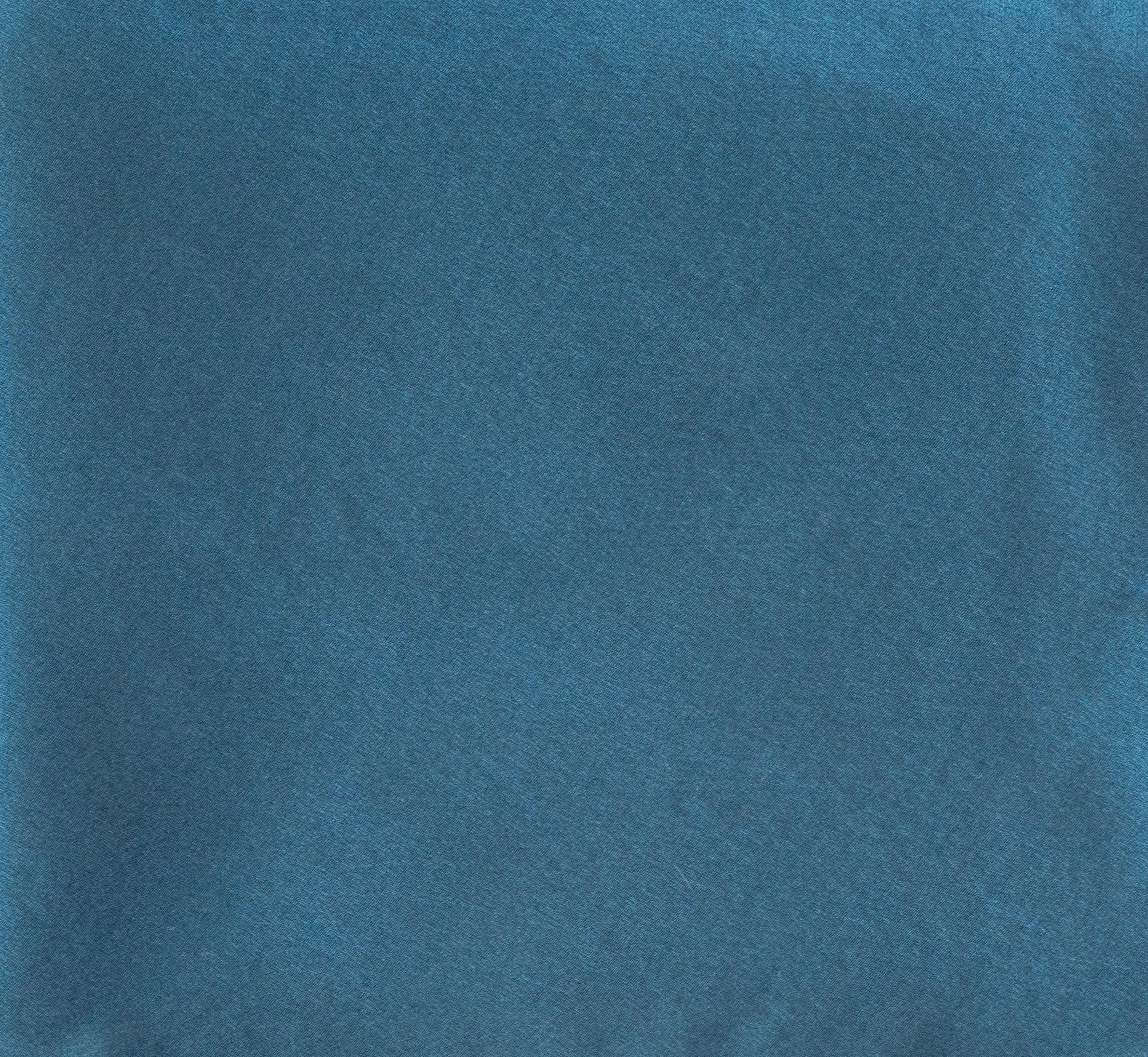
Color swatches are for illustrative purposes only. Actual results may vary based on many factors, and cannot be guaranteed.