

SUMAC EXTRACT
Sumac Extract
FOR BRIGHT, CLEAR COLORS
Shepherd Textiles Sumac Extract is made from the tannin-rich galls that form on the branches of rhus chinensis, the Chinese sumac. Sumac galls yield very clear, potent tannins that can be used to mordant cotton and linen, tan leather, or make iron gall ink. When used as a pretreatment on plant fibers, sumac tannins impart very little color of their own, but they are noted for producing bright and vibrant shades when paired with an aluminum mordant, and they will not make the fibers feel denser or heavier. An excellent choice for preparing cotton and linen before mordanting to dye bright and colorful hues.
Shepherd Textiles Sumac Extract is made from the tannin-rich galls that form on the branches of rhus chinensis, the Chinese sumac. Sumac galls yield very clear, potent tannins that can be used to mordant cotton and linen, tan leather, or make iron gall ink. When used as a pretreatment on plant fibers, sumac tannins impart very little color of their own, but they are noted for producing bright and vibrant shades when paired with an aluminum mordant, and they will not make the fibers feel denser or heavier. An excellent choice for preparing cotton and linen before mordanting to dye bright and colorful hues. Please see our guide to Dyeing With Sumac Extract for background, color recipes, and important safety information.
1. Background on Sumac
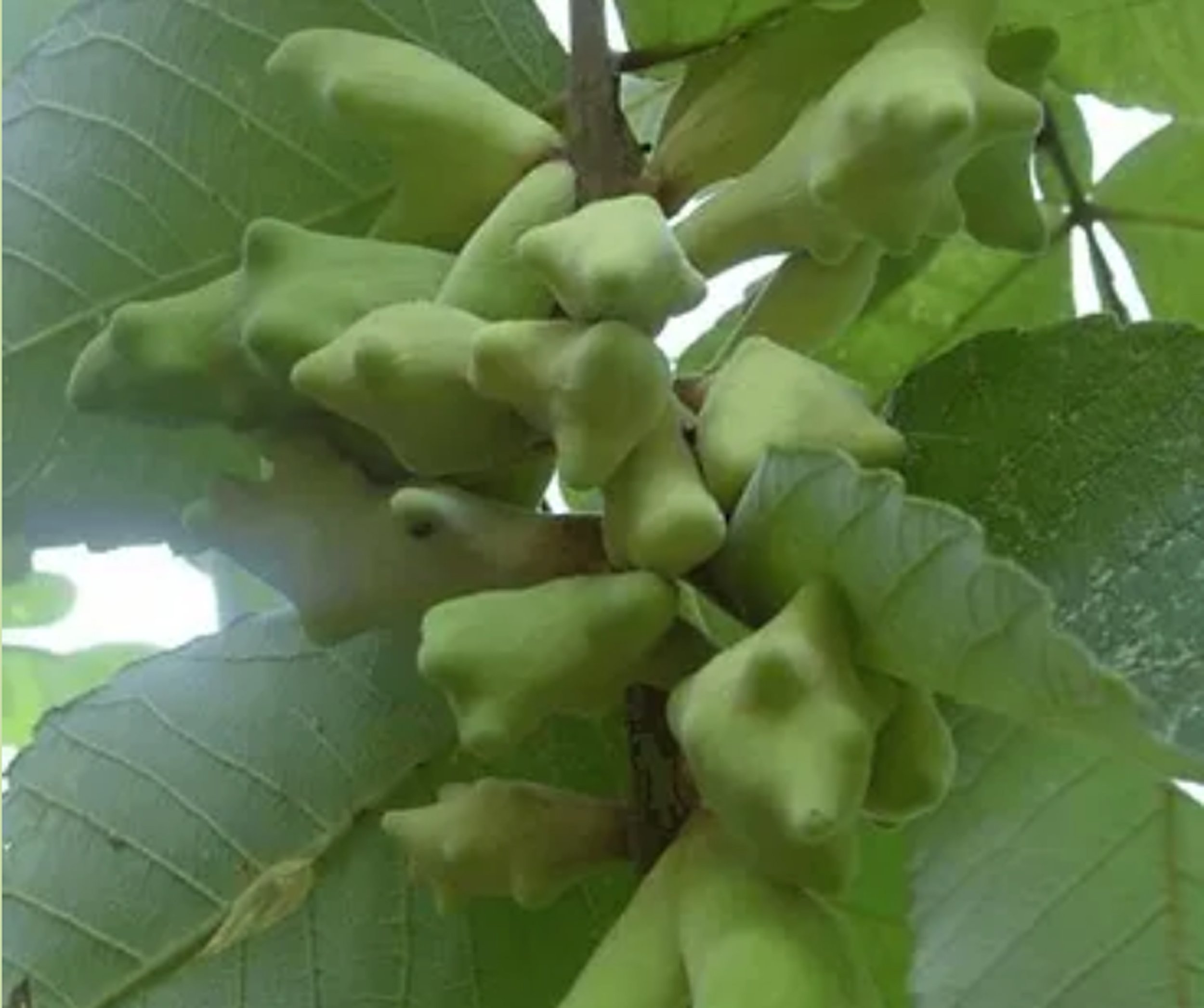
Shepherd Textiles Sumac Extract is made from galls that are harvested from the Chinese sumac tree, rhus chinensis. Chinese sumac is native to East Asia, but it belongs to the same family as the staghorn sumac rhus typhina that grows throughout the midwestern and eastern USA. Just like the staghorn sumac, the Chinese sumac is parasitized by a specialized aphid that evolved to take advantage of the tree’s tendency to form galls. The Chinese sumac aphid melaphis chinensis lays its eggs on the underside of sumac leaves and branches in the spring. Through a biological mechanism that is still not well understood, this triggers the sumac to grow a tannin-rich gall around the egg. The gall provides a protected space for the aphid eggs to hatch, and several (short-lived) generations of aphids are born inside the gall until adult aphids emerge from it in the autumn. Although considered a form a parasitism, this does not seem to cause any harm to sumac trees beyond the cosmetic.
Sumac galls are an especially rich source of clear gallotannins - some sources indicate that the dried galls contain as much as 60% or 70% tannin matter by weight. The galls have been collected for hundreds of years for tanning leather, dyeing fabric, making ink, and as an herb in Traditional Chinese Medicine. On their own, sumac galls produce little but a beige shade on cotton and linen. However, the nearly colorless tannins do any excellent job of combining with and fixing aluminum to treated plant fibers. The results can be quite dramatic, compared to mordanting cotton or linen that has not been treated with a tannin. When exposed to iron, the tannins in Sumac Extract form dark ferrous tannate complexes that have shades of blue-black, gray, or purple-brown. This is the same reaction used to produce iron gall inks, and it can be used to get various buff shades of gray and brown on plant fibers. Use at 10-12% weight-of-fabric to prepare cotton or linen for mordanting with aluminum mordants, or as much as 20% weight-of-fabric to get dark grays using iron.
2. Safety Precautions
This product is intended for textile projects only.
Do not ingest.
Avoid eye contact. If eye contact occurs, rinse well with cool water.
Avoid direct skin contact. If skin contact occurs, rinse well with cool water.
Wear gloves, a mask, and eye protection while handling the dry pigment. Work in a well-ventilated space, and wash hands after use.
Not for use in food, cosmetics, or hair care products.
Open carefully to avoid spilling or creating dust. If a spill occurs, quickly wipe up with a paper towel or disposable rag.
Sumac Extract can permanently dye clothing, countertops, rugs, utensils, or other property, especially when combined with iron. Avoid contact with anything not meant to be dyed.
Use only dye pots and utensils dedicated to dyeing. Do not use any pots, containers, spoons, tongs, thermometers, or other utensils that will be used for food preparation.
Metal mordants like ferrous sulfate are irritants and may be harmful if swallowed. Read your manufacturer’s safety data sheet (SDS) before use.
Sumac Extract, and all dye baths and mordant liquors made while dyeing, should be kept out of reach of children and pets. Use only with adult supervision.
Shepherd Textiles, LLC is not liable for any misuse of this product or any unintended staining of your clothing, workspace, or other property. Use only as directed.
3. Recommended Supplies

Dye pot. Use a stainless steel dye pot large enough to hold all your fibers, with plenty of room for them to move around and for the liquid to circulate freely.
Metal tongs. A pair of tongs is useful for stirring and taking fabric out. Use tongs dedicated to dyeing, and not for food preparation.
Rubber gloves. Wear rubber gloves while handling extract powder and while handling mordanted/dyed fiber before it is rinsed.
Candy thermometer. Use a thermometer to keep track of the proper temperature during mordanting and dyeing.
Scale. Use a scale to weigh out fiber, mordant, and extract powder.
Aluminum mordant. Sumac Extract’s main use is to fix mordants like aluminum to cotton and linen. The recipe below uses Aluminum Formate Pro, which is the most convenient, but other aluminum mordants like Aluminum Acetate and Aluminum Lactate will work equally well. See each product page for details.
Calcium carbonate (chalk). A chalk bath is used to fix aluminum mordants more fully. Note that we do not recommend using chalk to fix iron mordants, unless you are aiming for the purple-brown shade that results.
Recipes
4. Aluminum Colors on Cotton/Linen
Sumac Extract is one of the classic tannin fixatives for mordanting cotton and linen, and it produces excellent results when used at about 10% weight-of-fabric (WOF). The sumac galls that it is made from are extremely rich in hydrolyzable gallotannins which are very clear and will not impart brown or tan shades to the fiber. Sumac gall tannins are known to produce quite vibrant shades on cotton or linen that is subsequently mordanted with aluminum and dyed. They will not make the tanned fibers feel heavier or denser (in contrast to oak gall tannins which can produce darker, more opaque colors but can also make the fibers feel heavier). For this recipe we have paired Sumac Extract with Aluminum Formate Pro, but other mordants like Aluminum Acetate would work equally well.
Sumac Ext. 10% + 1% Cochineal
Sumac Ext. 10% + 6% Cochineal
Sumac Ext. 10% + 2.5% Onion Peel Extract
Sumac Ext. 10% + 2.5% Wild Madder Extract
Sumac Ext. 10% + 12% Coreopsis Extract
Scour (clean) the cotton or linen fibers well: Fill a dye pot with enough warm water for the fibers to move around freely. Add 1 gram of soda ash (sodium carbonate), plus 1 gram for each additional pound of fiber, plus a few drops of liquid soap. Add the fibers and raise the heat to a very gentle simmer. Simmer the fibers for one hour, stirring occasionally. After an hour, remove from the heat. When cool enough to handle safely, rinse well with warm water until the water runs clear.
Fill a dye pot with enough warm water for your fibers to move around freely. Weigh out 10% weight-of-fabric (WOF) of Sumac Extract, add to the water, and mix well until completely dissolved.
Gently add the cotton or linen. Bring the tannin bath just to a boil, then immediately remove the pot from the heat, cover it, and let the fibers steep until completely cool. For best results, let them steep overnight. Stir the fibers occasionally so that they absorb the tannin evenly. If you are steeping the fibers overnight, before going to bed make sure that there are no bubbles trapped underneath the fibers and that the fibers are fully submerged.
When ready to proceed, lift the fibers out of the tannin bath and gently squeeze excess liquid out (just enough so that they are not dripping). Do not rinse them. The tannin bath may be reused so long as it is not cloudy, although it may need to be topped off with more water and more Sumac Extract.
Fill a dye pot or plastic bucket with enough soft or distilled water for the fibers to move around freely. The water should be room temperature or slightly lukewarm, around 80-90°F (27-32°C).
Weigh out 10% weight-of-fabric (WOF) of Aluminum Formate Pro. Add to the mordant bath and mix well until fully dissolved. The mordant bath will turn a milky white color [note that other aluminum mordants like Aluminum Acetate and Aluminum Lactate could be used instead — see each product page for details].
Gently add your Sumac Extract-treated cotton or linen fibers to the mordant bath. Wearing rubber gloves, work the fibers in the liquid to make sure they are evenly saturated. Make sure they are completely submerged and no bubbles are trapped underneath.
Cover the pot or bucket and let the fibers steep for 2 hours. Stir the fibers a few times while they are steeping to make sure they mordant evenly. After 2 hours, the cotton or linen will be thoroughly mordanted with aluminum.
Prepare a chalk fixing bath: fill a bucket or dye pot with hot tap water (around 110°F/43°C). Measure out 10 grams of chalk (calcium carbonate) per liter of water. Add the chalk and mix well until dispersed. Wearing gloves, remove the cotton or linen from the mordant bath, gently squeeze out, then place it in the chalk fixing bath. Let the fibers steep in the fixing bath for 30 minutes. After thirty minutes the aluminum will be completely fixed on the fibers, improving the fastness of the dyed color.
Rinse the fibers. Wearing gloves, remove the cotton or linen from the fixing bath and rinse well until the water runs clear. It is important to rinse out excess mordant and tannin at this stage, because otherwise it will cause trouble later on in the dye bath (some of the excess mordant may bleed out into the dye bath and waste dye, and some of it may fix superficially to the surface of the fibers and make them tedious to rinse).
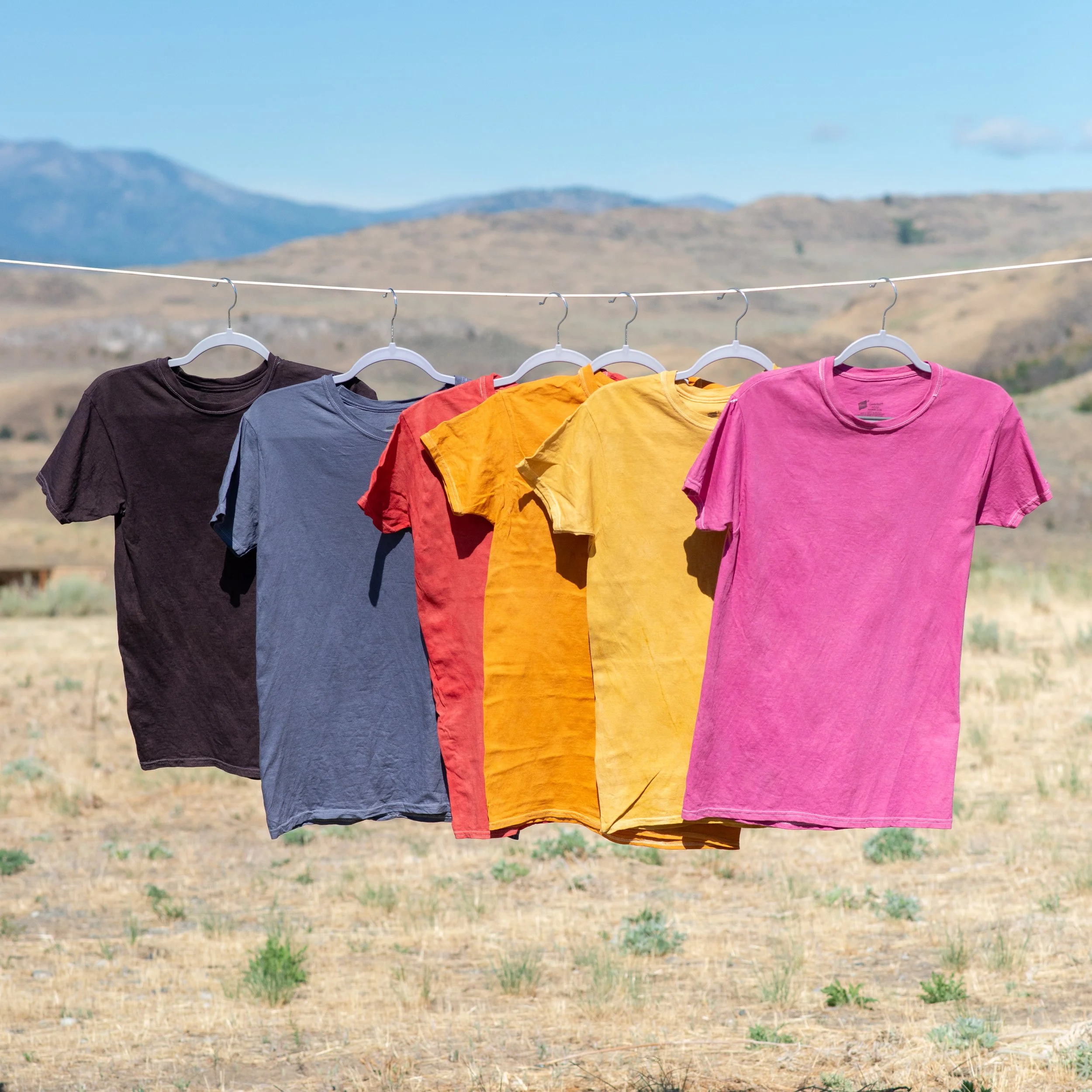
When the cotton or linen has been thoroughly rinsed, proceed directly to dyeing. The swatches above show cotton tshirts mordanted with Sumac Extract and Aluminum Formate Pro, then dyed with Cochineal, Wild Madder Extract, Onion Peel Extract, and Coreopsis Extract.
5. Iron Buffs on Cotton/Linen - Cold
When Sumac Extract is combined cold with an iron mordant it forms a beautiful blue-black compound known as ferric tannate (this is the same combination by which iron gall inks are made). However, the final color of the mordanted fibers will vary tremendously depending on how they are treated. Knecht (1910:268) says that “Goods which have been mordanted… with tannate of iron have a light brown or light grey to brownish-black or bluish-black appearance, the brown or blue being more decided according to whether the goods have been prepared with or without lime water.” Our results bear out his observation: the iron-mordanted cotton or linen will have a beautiful blue hue if rinsed only with soft water, a more matte gray if rinsed with moderately hard water (or acidified hard water), and a brown shade if exposed to very hard water (e.g., lime water). The blue colors in particular can be quite pretty when freshly dyed, although they are somewhat fragile and will tend to eventually oxidize toward a cool gray.
Sumac Ext. 20% + Iron 20%, Soft Water
Sumac Ext. 20% + Iron 20%, Hard Water
Sumac 20% + Iron 20%, Acidified Hard Water
Sumac Ext. 20% + Iron 20%, Hard Water, Soap
Sumac Ext. 10% + Iron 4%, Soft Water
Scour the cotton or linen fibers well.
Fill a dye pot with enough warm water for your fibers to move around freely. Weigh out 10% weight-of-fabric (WOF) of Sumac Extract for lighter grays, or 20% Sumac Extract if aiming for darker grays. Add to the water and mix well until completely dissolved.
Gently add the cotton or linen. Bring the tannin bath just to a boil, then immediately remove the pot from the heat, cover it, and let the fibers steep until completely cool. For best results, let them steep overnight. Stir the fibers occasionally so that they absorb the tannin evenly. If you are steeping the fibers overnight, before going to bed make sure that there are no bubbles trapped underneath the fibers and that the fibers are fully submerged.
When ready to proceed, lift the fibers out of the tannin bath and gently squeeze excess liquid out (just enough so that they are not dripping). Do not rinse them. The tannin bath may be reused so long as it is not cloudy, although it may need to be topped off with more water and more Sumac Extract.
Prepare an iron mordant bath: Fill a dye pot or plastic bucket with enough room-temperature water for the fibers to move around freely. The water used should be soft or distilled; hard water can cause the iron to precipitate prematurely. Weigh out between 4% and 20% weight-of-fabric of Ferrous Sulfate. Use 4% for lighter grays or 20% for medium to dark grays. Add to the water and mix well until fully dissolved.
Gently add your scoured cotton or linen fibers. They will instantly begin to turn gray. Wearing rubber gloves, work the fibers in the mordant bath to make sure they are evenly saturated. Make sure they are completely submerged and no bubbles are trapped underneath. Be careful when working the iron mordant bath, which is now full of what is essentially a weak iron gall ink. The black liquid in the bath can permanently stain things if it splashes out. It can also easily stain your fingers. If any liquid splashes out, wipe it up immediately.
Leave the fibers to steep in the ferrous sulfate bath. Very thin fabrics like cotton will need 1 to 1.5 hours; thicker or more densely woven fabrics may need 2 hours. The fibers will darken noticeably and shift toward a deeper gray. Stir the fibers a few times while they are steeping to make sure they mordant evenly.
After 1 or 2 hours, the fibers will have permanently saddened to a grayish shade. So long as soft or distilled water was used to make the iron mordant bath, the fibers will be a beautiful cool gray or a blue-black shade. The next steps will determine the final hue of the fiber:
For the deepest blueish grays, remove the fibers and rinse well in very soft or distilled water until the water runs clear.
For a purple-brown shade, remove the fibers and rinse well in hard water. If you have soft water, you can approximate hard water by adding 1 or 2 grams of calcium carbonate (chalk) to each gallon of rinse water. The color will shift to purple-brown after a few minutes of rinsing.
If you have hard water but want a more blueish or neutral shade of gray, you can “correct” your hard water by acidifying it with cream of tartar. Add 1 or 2 grams of cream of tartar per gallon of rinse water; this will reduce the tendency of the calcium in your hard water to shift the color to brown.
Letting the fibers steep for 5 or 10 minutes in a warm soap bath immediately after removing them from the iron mordant bath can sometimes deepen the color by precipitating more of the iron onto the fibers. We used half a teaspoon of Synthrapol for the shirt swatch pictured above. Note that our area has hard water, so the soap bath both deepened the color and shifted it toward a purple-brown.
Once the fibers have been fully rinsed and the water runs clear, hang up to dry somewhere out of direct sunlight. Be careful that the cotton or linen is placed somewhere where dripping dye will not cause any damage; an errant drip of iron-tannin water can cause a permanent stain. Dispose of the spent mordant bath according to local regulations.
6. Iron Buffs on Cotton/Linen - Hot
Historically, professional dyers applied iron to sumac-treated fibers without heat. They wanted to be able to re-use their iron baths rather than heating them up and precipitating all the extra iron (in which case the bath becomes useless for mordanting additional fibers). Instead, they would apply the iron without heat as in the previous recipe, and then use a second fixing bath to finish precipitating and darkening it — the preferred fixing agents being chemicals like sodium phosphate and sodium silicate which are not available to most natural dyers today. However, if we do not mind that we will not be able to re-use the iron bath, we can use heat to more fully precipitate the iron onto the fibers and get dark gray and black shades. The color will have a more blueish or brownish undertone depending on if the fibers are rinsed in soft water or hard water, similar to the previous recipe.
Sumac Ext. 20% + Iron 20%, Hard Water
Scour the cotton or linen fibers well.
Fill a dye pot with enough warm water for your fibers to move around freely. Weigh out 10% weight-of-fabric (WOF) of Sumac Extract for grays, or 20% Sumac Extract if aiming for a black or near-black. Add to the water and mix well until completely dissolved.
Gently add the cotton or linen. Bring the tannin bath just to a boil, then immediately remove the pot from the heat, cover it, and let the fibers steep until completely cool. For best results, let them steep overnight. Stir the fibers occasionally so that they absorb the tannin evenly. If you are steeping the fibers overnight, before going to bed make sure that there are no bubbles trapped underneath the fibers and that the fibers are fully submerged.
When ready to proceed, lift the fibers out of the tannin bath and gently squeeze excess liquid out (just enough so that they are not dripping). Do not rinse them. The tannin bath may be reused so long as it is not cloudy, although it may need to be topped off with more water and more Sumac Extract.
Prepare an iron mordant bath: Fill a metal dye pot with enough room-temperature water for the fibers to move around freely. The water used should be soft or distilled; hard water can cause the iron to precipitate prematurely. Weigh out between 4% and 20% weight-of-fabric of Ferrous Sulfate. Start with 4% for grays or use as much as 20% for blacks. Add to the water and mix well until fully dissolved.
Gently add your scoured cotton or linen fibers. They will instantly begin to turn gray. Wearing rubber gloves, work the fibers in the mordant bath to make sure they are evenly saturated. Make sure they are completely submerged and no bubbles are trapped underneath. Be careful when working the iron mordant bath, which is now full of what is essentially a weak iron gall ink. The black liquid in the bath can permanently stain things if it splashes out. It can also easily stain your fingers. If any liquid splashes out, wipe it up immediately.
Leave the fibers to steep in the ferrous sulfate bath for one hour. Stir the fibers a few times while they are steeping to make sure they mordant evenly. After an hour they will have mostly saddened to gray, and more importantly, the iron will have fully penetrated the fibers.
After 1 hour, turn on the heat and gradually raise the temperature to 160°F (71°C). Hold that temperature for 30 minutes, stirring occasionally so that the fibers mordant evenly. After 30 minutes, turn off the heat and let the fibers cool until they can be handled safely.
When cool enough to handle safely, remove the fibers and rinse well in warm water and a little soap. Rinse until the water runs clear.
Once the fibers have been fully rinsed and the water runs clear, hang up to dry somewhere out of direct sunlight. Be careful that the cotton or linen is placed somewhere where dripping dye will not cause any damage; an errant drip of iron-tannin water can cause a permanent stain. Dispose of the spent mordant bath according to local regulations.
*All text and images are copyright of Shepherd Textiles, LLC. Do not reproduce without permission and attribution.